You finally sit down after a demanding day, but your body seems to have missed the message that work is over. Your jaw remains clenched, your shoulders feel tight, and a conversation from six hours ago keeps replaying in your mind. You try taking a few deep breaths, only to become more conscious of your heartbeat. Even resting starts to feel like something you are doing incorrectly.
The frustrating part is that nothing particularly stressful is happening anymore. Yet the physiological processes involved in responding to demands do not necessarily stop when those demands end. Stress hormones, autonomic activity, learned patterns of attention, and repeated thoughts can continue influencing how alert or settled someone feels.
The vagus nerve plays an important role in this process, but not as the simple relaxation switch often described in wellness content. Understanding its actual function—and why different forms of tension respond to different interventions—offers a more useful starting point than trying to force the body to calm down.
Why Your Stress Response Doesn’t End When the Stressor Does
The body’s stress response involves two major physiological systems operating on different timescales. The sympathetic-adrenomedullary system supports rapid adjustments in cardiovascular activity and alertness, while the hypothalamic-pituitary-adrenal (HPA) axis coordinates a hormonal response involving cortisol. These processes help the body allocate resources when circumstances demand attention or action.
Recovery involves more than reversing those changes. Cardiovascular activity, hormone levels, muscle tension, and cognitive engagement may follow different recovery trajectories. A person might stop feeling emotionally upset while continuing to experience physical tension, or feel physically tired while remaining mentally preoccupied.
One reason is that the brain can respond to anticipated and remembered demands, not only immediate events. Researchers describe persistent worry and rumination as perseverative cognition. In a meta-analysis of 60 studies, Ottaviani and colleagues found associations between perseverative cognition and elevated blood pressure, heart rate, cortisol, and reduced heart-rate variability (Ottaviani et al., 2016). These findings help explain why replaying an argument or anticipating tomorrow’s workload can maintain physiological activity after the original situation has passed.
This is particularly relevant to work-related stress. Checking messages after dinner, mentally rehearsing unfinished conversations, and anticipating unpredictable demands can repeatedly redirect attention towards the same concerns. The practical consequence is that recovery may require reducing exposure to those cues and resolving what can be resolved, rather than simply sitting still and waiting for tension to disappear.
What the Vagus Nerve Actually Contributes to Recovery
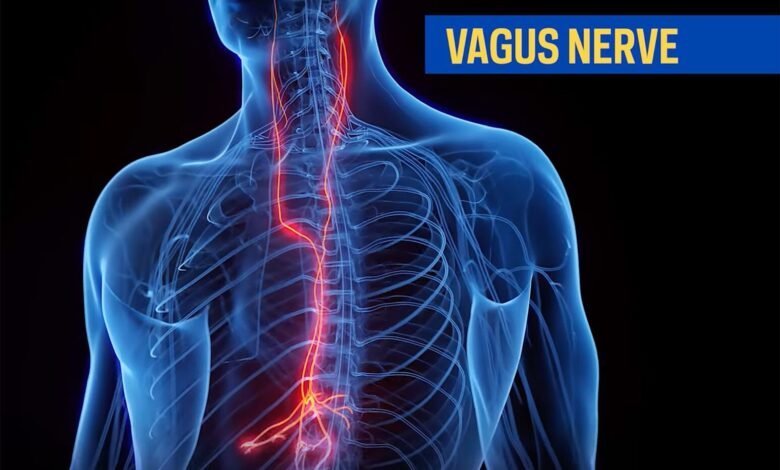
The vagus nerve is the tenth cranial nerve and a major communication pathway between the brainstem and organs involved in cardiovascular, respiratory, and digestive regulation. Most of its fibres carry sensory information towards the brain, while other fibres contribute to control of peripheral functions. It is an important component of parasympathetic regulation, particularly through its influence on cardiac activity.
During normal breathing, heart rate often rises slightly during inhalation and falls during exhalation. This phenomenon, called respiratory sinus arrhythmia, involves changes in cardiac vagal influence alongside other cardiovascular mechanisms. It illustrates how autonomic regulation is continuously adjusted rather than switched between completely separate states.
The popular idea that the sympathetic nervous system controls stress while the parasympathetic system controls relaxation is a useful introduction, but it becomes misleading when taken literally. Both divisions can be active simultaneously, and their interaction depends on the physiological task. The vagus nerve also participates in functions unrelated to subjective relaxation, including gastrointestinal signalling and cardiovascular reflexes.
Understanding how the vagus nerve relates to stress recovery therefore requires separating three concepts: autonomic activity, the body’s response to a stressful event, and the conscious feeling of being relaxed. They influence one another, but they are not interchangeable.
Heart-rate variability provides a useful example. RMSSD, a commonly reported HRV measure, reflects aspects of short-term cardiac parasympathetic modulation. However, its value also depends on breathing, posture, exercise, medication, and measurement conditions. A higher HRV reading does not automatically mean someone is emotionally calm, just as a lower reading does not demonstrate that their nervous system is damaged.
The important conclusion is that stress recovery is a coordinated process. No single nerve, breathing pattern, or wearable measurement provides a complete picture of whether someone has recovered.
Why Trying to Relax Can Make You Feel More Tense
For some people, attempts to relax create an unexpected problem: the more closely they monitor their bodies, the more noticeable their discomfort becomes. A person sits down to meditate and immediately notices a racing heartbeat, tight chest, or uneven breathing. They interpret those sensations as evidence that the exercise is failing, which gives them another reason to feel concerned.
This involves interoception, the perception and interpretation of signals originating inside the body. Interoceptive awareness is useful for identifying hunger, exertion, and other internal states, but the meaning assigned to a sensation can change how someone responds to it. A noticeable heartbeat after climbing stairs may be unremarkable; the same sensation during a quiet meditation session may feel threatening to someone already worried about their physical state.
Attention can intensify this experience. When a person repeatedly checks whether their breathing has slowed or their muscles have relaxed, ordinary fluctuations become more prominent. Attempts to suppress those sensations may create a cycle of monitoring, concern, and renewed attention. This does not mean body awareness is inherently harmful. Interoceptive techniques are also used therapeutically, but their usefulness depends on context, interpretation, and how they are practised.
For someone who becomes uncomfortable during inward-focused exercises, an externally focused activity may be a better starting point. Walking, listening to familiar music, or completing a simple household task can redirect attention without requiring continual evaluation of bodily sensations. A structured exercise with a defined duration may also be easier to follow than open-ended meditation.
The practical lesson is that relaxation techniques should match the person’s response to the exercise. Feeling more distressed during a particular practice is not a reason to push harder; it is a reason to adjust the method.
How to Identify What’s Keeping You Alert
Different experiences of lingering stress can arise from overlapping mechanisms. Recognising the dominant pattern helps narrow the choice of intervention, although the symptoms themselves are not sufficient for diagnosis.
| What you notice | Possible contributing process | More useful starting point |
| Replaying work conversations | Rumination and continued anticipation of demands | Record the next action and establish a work cutoff |
| Tight jaw, shoulders, or hands | Sustained muscular tension | Progressive muscle relaxation |
| Shallow or hurried breathing | Altered respiratory rhythm during arousal | Comfortable, slower breathing |
| Feeling worse when sitting still | Heightened monitoring of internal sensations | Walking or externally focused activity |
| Calm but unable to fall asleep | Sleep pressure, circadian timing, or sleep-related difficulties | Review wake times, light exposure, and sleep patterns |
The distinctions matter because a technique can influence one component of stress without addressing another. Progressive muscle relaxation, for example, directly targets the experience of muscular contraction and release. It may provide physical relief while leaving unresolved worries unchanged. Similarly, slow breathing can alter cardiovascular rhythms without resolving the workload or conflict that repeatedly activates a person’s concerns.
For someone experiencing several patterns simultaneously, a sequence may work better than one isolated exercise. Addressing unfinished tasks before beginning a seated relaxation practice can reduce cognitive interruptions, while a few minutes of movement may make the transition to stillness more comfortable.
The objective is not to identify a single biological defect. It is to avoid applying the same generic advice to problems that involve different contributing processes.
Which Relaxation Methods Have the Strongest Practical Rationale?
Slow-paced breathing has a particularly clear physiological mechanism. Respiratory rhythm interacts with cardiac vagal modulation and the baroreflex, a feedback system that helps regulate blood pressure. Breathing at a slower, comfortable pace can alter cardiovascular oscillations, sometimes producing noticeable changes in HRV.
A 2024 meta-analysis of 31 studies involving 1,133 participants reported immediate improvements in several cardiovascular measures following slow-paced breathing, including reductions in heart rate and systolic blood pressure. However, the pooled effect on negative emotion was less conclusive (Shao et al., 2024). This distinction matters: measurable physiological responses do not guarantee an immediate feeling of calm.
A practical starting point is to inhale gently for approximately four seconds and exhale for five or six seconds, continuing for three to five minutes without forcing unusually deep breaths. The pace should be adjusted if it creates discomfort, dizziness, or breathlessness. Someone who becomes anxious when concentrating on respiration may benefit more from another technique.
Progressive muscle relaxation addresses a different target. Briefly tensing and releasing muscle groups can help people identify sustained contraction, particularly in the shoulders, hands, and jaw. The method provides physical feedback that may be easier to recognise than the broader instruction to “relax.” It is especially relevant when muscular tension is the most noticeable feature of someone’s stress response.
Walking and gentle movement offer another approach. They change physical context, redirect attention, and provide a transition away from sedentary work. Their value does not depend on achieving a particular breathing rate or autonomic measurement.
Across these methods, the useful distinction is between a technique’s biological mechanism and the circumstances in which someone is likely to practise it. An effective exercise has limited practical value if it consistently increases discomfort or requires more concentration than the person can comfortably sustain.
Where Non-Invasive Vagus Nerve Stimulation Fits
For people who find self-directed relaxation difficult, structured sensory stimulation offers another type of experience. Unlike breathing exercises, which alter respiratory behaviour, transcutaneous auricular vagus nerve stimulation (taVNS) applies controlled electrical pulses through electrodes positioned on selected regions of the outer ear.
The anatomical rationale involves the auricular branch of the vagus nerve, which supplies sensory innervation to portions of the external ear. Electrical stimulation at these sites is intended to engage afferent pathways associated with brainstem processing. However, nearby sensory nerves may also be activated, and stimulation effects depend on electrode position, intensity, pulse characteristics, and individual anatomy.
International research recommendations emphasise reporting these parameters because protocols differ considerably between studies (Farmer et al., 2021). The scientific interest is substantial, but results obtained with one device or stimulation protocol cannot automatically establish the benefits of another.
For everyday wellness use, the more immediate question is how stimulation fits into a manageable session. Someone who finds open-ended meditation difficult may prefer a predictable activity with a defined beginning and end. In this context, ZenoWell’s ear-worn wellness device is an example of a purpose-designed auricular stimulation system that offers preset routines rather than requiring users to configure individual electrical parameters.
ZenoWell’s Luna Relax mode uses an intermittent four-second stimulation and four-second pause pattern. Its published guidance also describes pairing the stimulation rhythm with gentle breathing, while adjusting intensity to a comfortable level and following the specified earpiece positioning instructions. This provides a concrete session format for someone interested in combining sensory cues with an evening relaxation practice.
The distinction between a defined user experience and a proven medical effect remains important. A structured session may be easier for some people to follow, but that does not demonstrate that it treats anxiety or produces a particular autonomic outcome. Consumers should evaluate the comfort, intended use, contraindications, and evidence relevant to the exact device.
Building a Recovery Routine Around Your Stress Pattern
A recovery routine works best when it begins with the source of continued activation rather than a predetermined collection of wellness activities. For someone who repeatedly thinks about unfinished work, the first step may be creating an explicit endpoint: write down tomorrow’s priorities, identify anything requiring immediate action, and close work notifications where possible. This addresses the cognitive process that may otherwise continue throughout the evening.
If the dominant experience is physical restlessness, a brief walk or gentle movement may provide a more comfortable transition than immediately sitting down to meditate. Once movement feels less necessary, a short breathing or muscle-relaxation exercise can follow. If a person prefers guided activity, an appropriate wearable session may be considered, with its duration and intensity determined by the product instructions rather than an improvised schedule.
A simple approach is to select only one technique from each relevant category:
- Persistent thoughts: Set a clear boundary around unfinished work and record the next actionable step.
- Physical tension: Use gentle movement or progressive muscle relaxation.
- Uncomfortable breathing: Practise slow, unforced breathing for a short period.
- Difficulty following an unstructured exercise: Try a guided or clearly timed routine.
These activities do not need to eliminate every uncomfortable sensation to be useful. Their purpose is to interrupt specific patterns that keep someone engaged with the day’s demands.
A routine should also be evaluated through concrete observations. Is the person checking work messages less often? Are evenings becoming easier to organise? Does the chosen method remain comfortable and manageable? These questions provide more useful feedback than expecting every session to produce a dramatic change in mood or HRV.
For someone whose sleep schedule is irregular, relaxation may need to be considered alongside consistent wake times and appropriately timed light exposure. Feeling calmer is not equivalent to shifting circadian timing, and no short relaxation session can compensate indefinitely for inadequate sleep opportunity.
When Persistent Tension Needs Medical Attention
Stress-related symptoms can overlap with medical and psychological conditions. Persistent palpitations, significant sleep disturbance, chronic pain, anxiety disorders, medication effects, and thyroid problems may require professional evaluation rather than additional relaxation exercises.
There is also an important difference between occasional difficulty unwinding and a situation in which the demands themselves remain excessive. Someone facing an unsustainable workload, ongoing conflict, or unpredictable working hours may need practical changes or professional support alongside any relaxation practice.
Non-invasive electrical stimulation has its own safety considerations. People with implanted electrical devices, significant cardiac conditions, seizure histories, pregnancy, or other relevant health concerns should review product-specific contraindications and consult an appropriate clinician. New chest pain, fainting, or serious breathing difficulty warrants prompt medical attention.
Wellness routines should support recovery without delaying necessary healthcare or making people feel responsible for controlling every physiological response.
The Bottom Line
Difficulty unwinding after stress is not simply a failure to activate the parasympathetic nervous system. Repetitive thinking can sustain physiological activity, attention can amplify uncomfortable bodily sensations, and different components of the stress response may recover at different rates.
The vagus nerve contributes to autonomic regulation, but no single measure or stimulation technique captures the entire recovery process. The most useful strategy is to identify what is maintaining alertness and choose a method directed at that problem: clearer boundaries for rumination, movement or muscle relaxation for physical tension, comfortable breathing for respiratory arousal, and structured sessions when open-ended practices are difficult to follow.
The outcome worth pursuing is not an instant nervous system reset. It is a more reliable transition from demanding activity to a period in which the body and mind no longer need to remain continually engaged.
References
- Ottaviani, C., et al. (2016). Physiological Concomitants of Perseverative Cognition: A Systematic Review and Meta-Analysis. Psychological Bulletin, 142(3), 231–259.
- Shao, R., Man, I. S. C., & Lee, T. M. C. (2024). The Effect of Slow-Paced Breathing on Cardiovascular and Emotion Functions: A Meta-Analysis and Systematic Review. Mindfulness, 15, 1–18.
- Farmer, A. D., et al. (2021). International Consensus Based Review and Recommendations for Minimum Reporting Standards in Research on Transcutaneous Vagus Nerve Stimulation (Version 2020). Frontiers in Human Neuroscience, 14, 568051.
- Farris, S. G., et al. (2025). Getting Comfortable with Physical Discomfort: A Scoping Review of Interoceptive Exposure to Bodily Sensations in Physical and Mental Health Conditions. Psychological Bulletin, 151(2), 131–191.