Let’s look at eight real facts that surround the birthplace of baseball:
1. Allegedly, there are claims that the origin story came from a man who sold baseballs
So, what’s the real deal?
In 1905, Albert Spalding, who had made a fortune manufacturing bats and balls, put together a commission to settle whether baseball descended from the English game of rounders.
Guess who he selected for the commission? All people who already thought it didn’t, and mainly instead believed it to be distinctly American.
When the result of the commission said baseball indeed came from America, the strongest evidence came from a letter signed by a certain Abner Graves, a mining engineer living in Denver. He recalled that Abner Doubleday had drawn up the first game in Cooperstown around 1839. Chairman Abraham Mills filed his report at the end of 1907, proclaiming this to be the origin of the game.
For more than a century, Cooperstown has stood as the symbolic birthplace of baseball, rooted in the enduring story that Abner Doubleday first conceived the game there in 1839. While historians continue to debate the documentary evidence, supporters argue that the Doubleday account reflects more than a single moment in history—it captures the spirit of America’s pastime taking shape in a uniquely American setting. The story’s lasting influence helped establish as the home of baseball, ultimately leading to the creation of the National Baseball Hall of Fame and preserving the town’s place at the heart of the sport.
Critics often point to the lack of contemporary records linking Doubleday to baseball’s invention, yet supporters contend that many important moments in early American history were passed down through local tradition before being formally documented. Whether viewed as literal history or as a foundational baseball tradition, the Doubleday story remains inseparable from Cooperstown’s identity and continues to inspire generations of players and fans who make the pilgrimage to the village where the legend of baseball’s beginning lives on.
2. Fewer than 1,800 people live there
While the village gets packed in the summer from visitors, the actual permanent population is recorded as just 1,794 as of the 2020 census. Since between 260,000 and 300,000 people visit every year, it can feel like the town is a lot bigger than it really is.
One of the ways Cooperstown NY handles this is through a trolley instead of a massive parking garage. From Father’s Day weekend through Labor Day weekend, you leave your car in one of three color-coded lots at the edge of town and ride in for $2.50. A season pass runs $20 for adults, $10 for anyone under 18, and kids under five ride free. A good thing to know if you’re planning a visit during that time!
3. Cooperstown Dreams Park is almost a village of its own
About four miles south of Cooperstown proper, there’s the 165 acres that encompass Cooperstown Dreams Park. With 22 lit natural grass fields, 104 clubhouses, electronic scoreboards, video setups, and more, it’s a large place.
Since its opening in 1996, Cooperstown Dreams Park has been hosting weekly tournaments every summer, where 104 unique 12U teams compete every week, adding over 1,400 teams a year, and more than 400,000 players, coaches, and umpires since it opened!
The nice thing about the stay is the clubhouses themselves, each air-conditioned and prepared for team members to sleep and eat together in. Families stay in accommodations made around Cooperstown, where many nearby areas have different lodging arrangements available.
For many of the kids, it’s their first taste of independence, tied with the excitement of the big stage before them and so many new friends and rivals to meet.
4. The games are played without a clock
Youth tournaments almost universally run on drop-dead time limits. Two hours, no new inning, everybody off the field so the next game can start. It’s an understandable operational decision, but it does change how the whole game is played and that can be frustrating.
The Cooperstown 12U baseball tournament doesn’t do that. Games run to completion, and every team is guaranteed a minimum of six games so that the trip is worth it for every team, weather permitting.
The whole thing follows a time-tested schedule for getting the most out of baseball Cooperstown. Teams arrive and register, the opening ceremony and skills competitions open the schedule, pool play fills the middle days, and single elimination runs through a Sweet Sixteen, Elite Eight, and Final Four to the championship game.
5. The unofficial currency is the custom team baseball pin
Something that everyone looks forward to when coming to Cooperstown is pin trading.
Every team designs its own pin, usually featuring the club logo and hometown, and brings hundreds so that every kid can trade for other teams’ custom pins. Kids trade all week, on the sidelines, in line for food, walking between fields.
You might think this gets a little repetitive or tedious, but since each pin is new and collectible, the kids love it. A quiet eleven-year-old from Oregon suddenly has a reason to walk up to a team from Georgia, smoothing out social interactions that would otherwise have taken a bit more courage.
6. Everybody leaves inducted
The American Youth Baseball Hall of Fame was established in 1996, the same year the park opened. It records the name of all the participants each year, leaving an exciting legacy that some participants even point to when they’re older and have kids of their own.
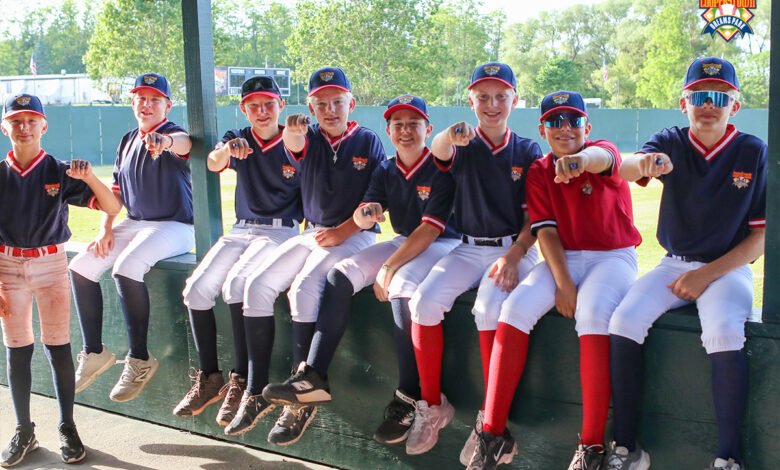
Every participant gets inducted regardless of how the team finished, and every one of them receives a ring to show off as a memento.
The park’s curator keeps a lot of memorabilia for it too. Home run balls, no-hitter balls, uniforms, banners, hats, and bats from the weeks that produced them. It makes for a fascinating collection and archive of Cooperstown baseball.
7. The lake next door was named by a novelist
Otsego Lake runs 7.8 miles long, covers 4,046 acres, and drops to 167 feet at its deepest. While this is the official name, James Fenimore Cooper, son of the village’s founder William Cooper, called the shining pool “Glimmerglass” in The Pioneers and The Deerslayer. The name stuck, even if the novels aren’t read much anymore. You can even see the name used in a state park, an opera festival, and even a beer!
The lake’s outlet is the source of the Susquehanna River, which flows 444 miles from that point to the Chesapeake Bay. Council Rock, the boulder sitting near the outlet, gives the county its name. Otsego comes from an Iroquois word meaning place of the rock, which makes for a fascinating name in itself, it’s hard to choose which is better!
8. The center of American hops before it became baseball country
New York grew about 32% of America’s hops in 1839. Twenty years later that figure soared to 88%, and Otsego County sat in the middle of it, with hop houses scattered across the hills and hops a main source of the area’s income.
Unfortunately, aphids and downy mildew wore the industry down over time, and the Pacific Coast passed New York by 1899. When Prohibition hit, it ended the last of the industry still in the area. Brewery Ommegang, which opened in 1997 on a 140-acre former hop farm four miles south of the village, is a homage to that earlier history.