You’ve seen the iceberg. Everyone has seen the iceberg: a neat triangle, the sunny tip above the waterline labelled “surface web,” a vast blue-black mass underneath labelled “deep web,” and “dark web” scrawled somewhere near the bottom in red.
It’s a good graphic and a bad explanation. Not because the proportions are wrong — they’re roughly right — but because it collapses two entirely different things into one shapeless blob below the waterline. Most of what sits down there is ordinary. Your bank statement is down there. So is your dentist’s booking system. The dark web is a smaller and much stranger neighbourhood, and it isn’t simply “the deep web, but more so.”
Separate the layers properly and a lot of the internet stops being mysterious. So do a lot of headlines.
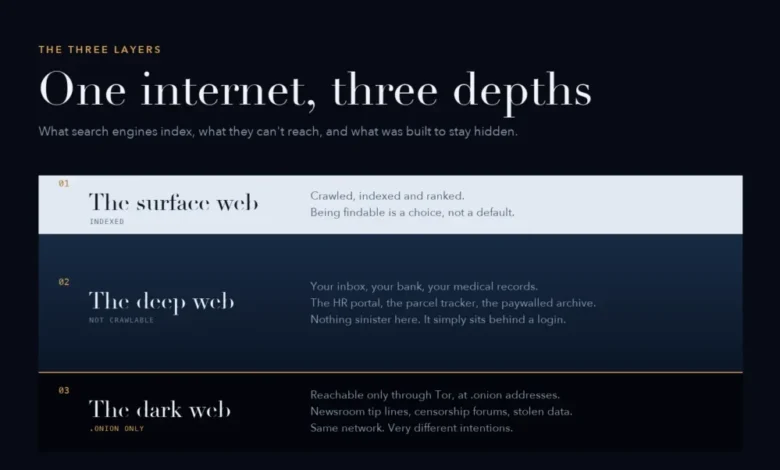
The three layers, and why the usual iceberg graphic flattens them.
Layer one: the part Google can see
The surface web is what search engines have crawled, indexed, and decided to rank. News sites, shops, Wikipedia, this magazine, the restaurant you’re going to order from tonight.
Its size is hard to pin down, and anyone quoting a precise percentage is guessing. The number that gets repeated — around 4 to 5 percent of the total internet — traces back to estimates made decades ago, when the web was a different animal. Treat it as a shape rather than a measurement. The surface web is small precisely because being visible is a deliberate act: you have to let the crawlers in.
There’s a consequence here that rarely gets mentioned. If a page isn’t indexed, it effectively doesn’t exist for most people. The surface web isn’t “the internet.” It’s the internet that has been optimised to be found, which is a much narrower thing. And being findable has never been the same as being true. A good deal of what ranks is duplicated, auto-generated, or simply wrong, which is its own kind of hiding.
Layer two: the boring 90 percent
The deep web is everything a search engine can’t reach. Not because somebody is hiding it, but because of how the plumbing works.
Your email inbox is deep web. So is your online banking, your medical records, the HR portal you log into on Mondays, the paywalled archive you use for work, your company’s internal wiki, the tracking page for a parcel, and the thousands of database-driven pages that only assemble themselves after you type something into a search box.
None of that is sinister. It is simply not crawlable, because it sits behind a login, a paywall, a form, or a permission. The term was coined by a librarian, Michael Bergman, in 2001, and he meant something closer to “hard to search” than “secret.”
The usual estimate is that the deep web accounts for something north of 90 percent of the total. That figure gets recycled endlessly and should be handled with tongs, because nobody has ever measured it properly. It’s also beside the point. The deep web is mostly the internet doing its admin, and nobody wants Google to index their tax return.
Layer three: the part built to stay hidden
The dark web is different in kind, not just in degree. It’s a set of services that exist only inside anonymity networks, chiefly Tor — the onion router — which was developed with US Navy funding in the mid-1990s and now runs as a nonprofit.
Traffic bounces through several volunteer relays, each peeling off one layer of encryption, which is where the onion metaphor actually comes from. Those services live at .onion addresses. They don’t resolve in Chrome or Safari. You need the Tor Browser, and you should only ever download it from torproject.org.
The anonymity cuts both ways, and that is the part that tends to get lost. On the dark web you’ll find SecureDrop inboxes run by major newsrooms, official onion mirrors of the BBC and the New York Times, a whistleblower channel for the CIA, and forums used by people living under censorship. You’ll also find fraud, stolen data, and marketplaces selling things that will get someone arrested. Both are true at once. That’s what a tool with no identity layer looks like.
One technical detail explains a lot of the frustration people hit. Until late 2021, onion addresses were 16 characters long. Tor retired that entire generation of addresses in October 2021, so anything with a short address is permanently dead rather than temporarily down. Current addresses run to 56 characters. If a tutorial, a list, or a screenshot shows a short one, it predates the change and can be ignored.
Where the link lists come in
Because .onion addresses are 56 characters of noise, nobody memorises them. You find them through directories: curated lists of links, sorted by category, re-checked as sites go offline.
The best known of these carries the name Hidden Wiki, and it has been the internet’s default starting point for onion links since around 2007. It is not one site. It’s a name that dozens of sites have used — some careful, some careless, some outright fraudulent — and the quality varies wildly. The versions worth using tell you when they last checked their links and keep a public record of the scams they have caught. Anything else is a coin flip.
Which is the practical advice, really: judge a directory by how it is maintained, not by how impressive its category list looks.
The myth of the “real” one
Here’s the part that surprises people. There is no official, canonical version left, and there hasn’t been for over a decade.
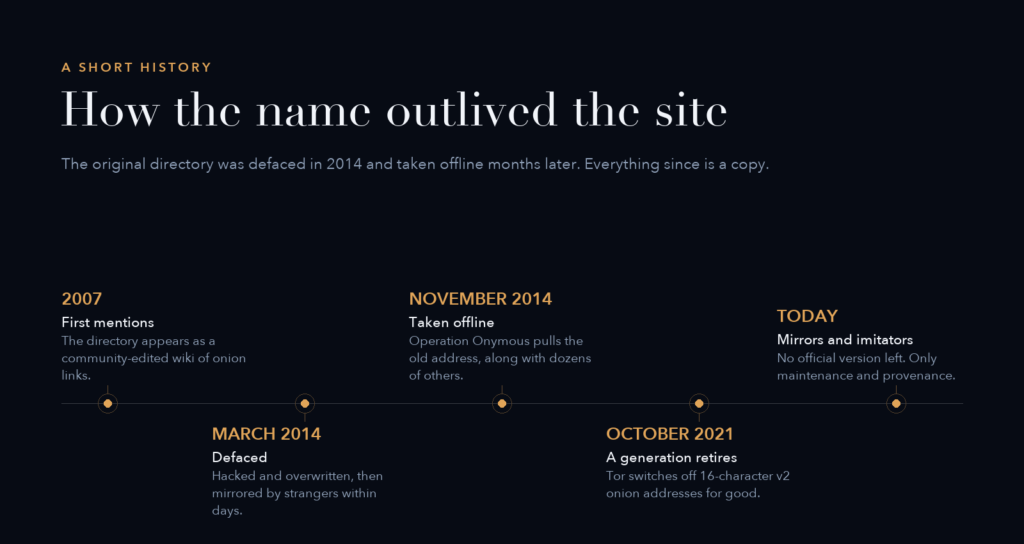
Four dates that explain why the name outlived the site.
The original was community-edited, a genuine wiki in the old sense, and by the early 2010s it was the front door to the Tor network. In March 2014 it was hacked and defaced. Later that year, during an international police operation called Operation Onymous, its old address was taken offline alongside a long list of other onion services. What survived was copies: mirrors, forks, and imitations, some maintained by people who cared and plenty maintained by people who wanted your login details.
So when a site claims to be the Hidden Wiki, the honest answer is that so do forty others. That isn’t cynicism, it’s just history. The name outlived the thing it named.
There’s a second-order lesson in that, and it travels well beyond Tor. Trust on the internet has always been a problem of provenance. A familiar name isn’t evidence. A padlock isn’t evidence. The only real evidence is whether you can trace a claim back to something with a reason to be right — and on a network built to hide provenance, that check is harder, and therefore more important.
Three things the dark web isn’t
- It isn’t a place. There’s no door and no address you can drive to. It’s a routing protocol and a set of services built on top of it.
- It isn’t illegal. Using Tor is legal in most countries, and so is reading a link directory. What you do on the other side of a link is where the law starts, and that varies enormously by jurisdiction. This isn’t legal advice; it’s the general shape of the thing.
- It isn’t mostly crime. Count the services and the largest categories are mirrors of ordinary sites, forums, and dead links. The crime is real, well-publicised, and a minority of the total — which is exactly why it dominates the coverage.
Why any of this should matter to you
Fair question. Most people will never install Tor, and they don’t need to.
But the three-layer model earns its keep because it is ordinary. It explains why “your data is on the dark web” usually means “a password you reused in 2016 turned up in a breach.” It explains why a page disappearing from Google isn’t the same as a page being deleted. It explains why anonymity tools exist at all, and why the people who need them most are rarely the ones in the headlines.
It also makes you harder to sell to. A large amount of cybersecurity marketing depends on you not knowing the difference between the deep web and the dark web. Once you do, “we monitor the dark web for you” stops being a reassuring sentence and becomes a specific, answerable question: monitoring what, exactly, and what will you do when you find it?
If you want one concrete thing to do tonight, it costs nothing. Search your own email address on a breach-checking service, then change any password that shows up, especially if you have reused it anywhere. That single habit protects you more than most subscriptions do.
The short version
Three layers, three different reasons for being hard to find. The surface web is optimised to be seen. The deep web is simply behind a door. The dark web was built so that the door can’t be traced back to you — which is why it attracts both whistleblowers and fraudsters, and why a directory is only ever as good as its last update.
The iceberg graphic isn’t wrong. It’s just too tidy. Real infrastructure rarely is.