From First Sample to Repeat Orders: How to Plan a Private Label Jewelry Collection

Launching a private label jewelry collection can be an attractive opportunity for independent brands, online retailers, boutique businesses, and fashion entrepreneurs.
However, the challenge is not simply finding a supplier. A successful collection requires thoughtful product selection, realistic order planning, sample approval, consistent branding, and a manufacturing process that can support future replenishment.
Working with a suitable private label jewelry manufacturer can help businesses organize these activities without building their own production facilities.
Here is a practical framework for planning a first jewelry collection and preparing it for long-term growth.
1. Define Your Brand Position Before Selecting Products
Before contacting manufacturers, establish what your jewelry collection should represent. Start by answering four questions:
- Who is your target customer?
- What price range are you targeting?
- Which jewelry categories fit your brand?
- What makes your collection different from competing products?
For example, a minimalist everyday jewelry brand may prioritize simple necklaces, small hoops, and stackable bracelets. A fashion-oriented brand may prefer statement earrings, colorful accessories, and coordinated jewelry sets.
The purpose is to create a consistent collection rather than purchasing unrelated products simply because they look attractive.
2. Start With a Manageable Product Assortment
New brands do not necessarily need dozens of designs for their first launch. A smaller, carefully selected assortment can make it easier to manage product development, inventory, photography, and marketing.
One possible collection structure could include:
| Category | Example product direction |
| Earrings | Studs and everyday hoops |
| Necklaces | Pendant and layered styles |
| Bracelets | Chain and charm bracelets |
| Rings | Minimalist fashion rings |
| Sets | Coordinated jewelry combinations |
The actual product mix should reflect the brand’s target market and available budget. It is also important to distinguish between a product design and its variations. One necklace available in three colors may represent one design but three separate inventory SKUs. This distinction matters when calculating production quantities and inventory investment.
3. Choose the Right Product Development Model
There are several ways to build a private label collection.
Option A: Select Existing Styles
This is suitable when a brand wants to develop an initial assortment without investing heavily in original product development. The business selects suitable products and coordinates the necessary branding and packaging requirements.
Option B: Adapt Existing Designs
Some brands want a recognizable product direction without developing every component from scratch. Depending on product feasibility, modifications may include surface finish, color combinations, product dimensions, chains and components, decorative details, or branding elements.
Option C: Develop Original Designs
Original development is appropriate when a brand has its own sketches, reference images, CAD files, or technical specifications. This route may require additional design development, modeling, tooling, and sample revisions.
Each approach has different cost and production implications. The best choice depends on how much product differentiation the brand needs.
4. Understand MOQ Before Finalizing Your Collection
MOQ can significantly affect the financial planning of a first collection. However, buyers should avoid assuming that one minimum quantity applies to every jewelry product.
MOQ may vary according to:
- Product construction
- Material requirements
- Design complexity
- Color and size variations
- Logo application
- Packaging specifications
- Production setup requirements
It is also important to ask whether the MOQ applies per design or can be combined across different products. For example, ordering 100 pieces across five different styles may involve different production requirements from ordering 100 pieces of one style.
A supplier should clarify these details before the buyer commits to the collection.
5. Treat Sampling as a Product Approval Process
Samples are not simply preliminary products. They are the reference point for approving the final manufacturing specifications.
Before approving a sample, review:
Appearance: Does the product match the original design direction?
Dimensions: Are the proportions and measurements correct?
Material and finish: Do the actual material and surface finish meet the agreed specifications?
Construction: Are connections, settings, clasps, and other components suitable?
Branding: Is the logo correctly positioned and presented?
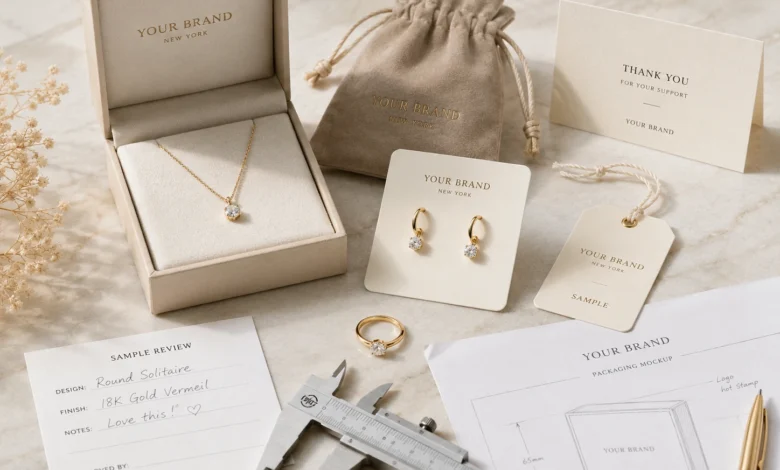
If changes are required, record them clearly. The final approved sample should be connected to the corresponding product specification. This is particularly important when the same item will be reordered later.
6. Plan Packaging Alongside the Jewelry
Packaging is an important part of a private label collection because it affects how customers experience the brand.
A typical branded presentation may include jewelry cards, individual pouches, retail boxes, product labels, care instructions, and branded inserts.
Not every product requires every packaging component. A small online jewelry business may begin with branded cards and pouches, while a premium retail collection may require more elaborate packaging.
The decision should consider product dimensions, shipping requirements, retail positioning, and total packaging cost. Also confirm whether packaging has a separate MOQ and production schedule.
7. Establish a Repeatable Quality and Reorder Process
The first production order is only the beginning. Once a product becomes popular, the brand may need to replenish inventory or expand the collection.
This is where documented specifications become valuable. A useful product record should include:
- Product reference and SKU
- Approved dimensions
- Material and finish
- Color references
- Logo positioning
- Packaging specifications
- Approved sample photographs
- Quality inspection requirements
When placing a repeat order, the buyer and manufacturer can refer to the same approved specifications. Any material or production changes should be reviewed before the next order is confirmed.
This creates a more manageable process as the collection grows.
8. Choose a Manufacturer That Supports the Entire Project
The right manufacturing partner should understand more than the product itself. Brands should evaluate whether a supplier can coordinate product selection, design adaptation, sampling, production, branding, packaging, and repeat orders.
HaoLustra is one example of a brand-focused manufacturing partner offering a structured private label jewelry program. Its published service information describes three product development paths: selecting existing styles, adapting available designs, and developing original products.
The program also covers sample review before bulk production, branding and packaging coordination, production support, quality checks, and repeat-order planning.
For businesses comparing manufacturing partners, HaoLustra’s private label jewelry program provides an example of how these stages can be organized around an individual brand’s requirements.
The exact product specifications, MOQ, sample costs, and production schedule still need to be confirmed for each project.
9. Think Beyond the First Collection
A good first collection should provide a foundation for future product development. After launch, brands can review:
- Which styles receive the most customer interest?
- Which products generate repeat purchases?
- Which colors and variations perform better?
- Which products should be replenished?
- Which designs deserve further development?
This information can guide the next manufacturing order. Instead of expanding the collection randomly, businesses can use actual sales performance and customer feedback to decide which products deserve additional investment.
Conclusion
Building a private label jewelry collection requires more than finding attractive products and adding a logo. The process involves defining a product direction, selecting suitable manufacturing methods, understanding MOQ, reviewing samples, coordinating packaging, and maintaining consistent production specifications.
For emerging jewelry brands, a carefully planned first collection can provide a more practical starting point for building a recognizable brand and developing a long-term manufacturing relationship.
The goal is to create a collection that is not only ready to launch but also manageable to replenish and expand.