
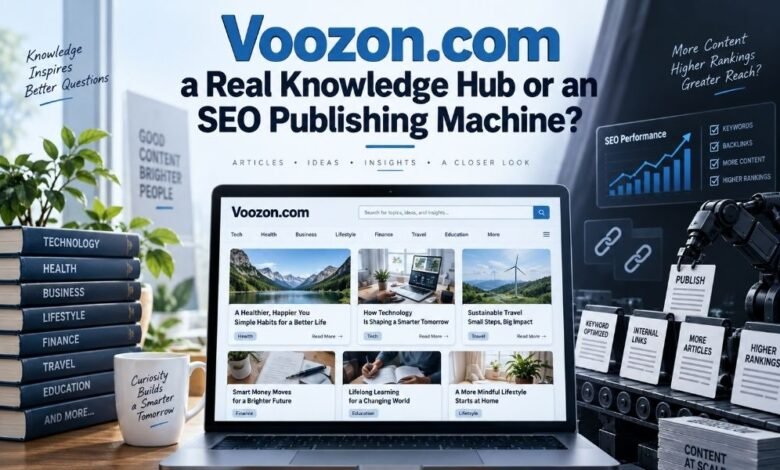
Voozon.com is the kind of website that makes readers ask an important question. Is it a real knowledge hub built to help people learn, or is it mainly an SEO publishing machine made for guest posts and backlinks? This question matters because the internet is full of websites that publish content on many topics. Some of them give useful answers. Others mainly exist to place links, attract traffic, and build search visibility.
Voozon.com sits in the middle of this debate because it presents itself as a multi-niche platform that covers topics like technology, business, finance, health, travel, education, lifestyle, and more. It also mentions guest posting and backlinks as part of its publishing model. Its own About page says it focuses on multi-niche publishing, guest posting, backlinks, fast article submission, and visibility building.
That mix makes Voozon.com interesting. A site can be helpful and still use SEO. SEO is not bad by itself. Many good websites use SEO so readers can find their work. The problem starts when SEO becomes more important than the reader. When a site publishes weak articles only to hold backlinks, trust can drop fast. This is why Voozon.com deserves a fair look. It should not be judged only because it accepts guest posts. It should be judged by the quality of its content, its editorial process, its sources, and how useful its pages are for real readers.
What Is Voozon.com Trying to Be?
Voozon.com appears to position itself as a broad digital media and guest publishing platform. It is not focused on just one subject. Instead, it covers many industries and gives writers, brands, and marketers a place to publish content. This kind of model is common today. Many websites try to become content hubs because they can reach different audiences from one domain.
A multi-topic site can be useful when it is organized well. A reader may visit one page for a tech guide and later find a business or lifestyle article. A marketer may see the site as a chance to publish a guest post. A small business may use it to gain visibility. A freelance writer may use it to build a portfolio. So, the idea behind Voozon.com is not automatically weak.
The challenge is depth. A website that writes about many topics must work harder to prove trust. A health article needs more care than a fashion trend article. A finance article needs clearer sources than a simple lifestyle post. A legal article needs careful wording because readers may treat it as advice. This is why broad platforms must show strong editorial standards. Without that, readers may wonder if the site is built for information or just for SEO output.
Why Multi-Topic Platforms Attract Writers and Marketers
Websites like Voozon.com attract writers and marketers because they offer reach. New writers often struggle to get attention. Their own blogs may have no traffic. Their social media pages may not bring steady readers. A guest publishing platform can give them a place to share ideas with a wider audience.
Marketers also like these platforms because content can support brand awareness. A guest post can introduce a company, explain a service, or show knowledge in a field. When done correctly, guest posting can be part of a clean content marketing plan. It can help a brand tell its story in a useful way.
Writers and marketers may choose multi-topic sites for several reasons:
-
They can publish content without building a full website.
-
They may reach readers in different categories.
-
They can build their name or brand online.
-
They can explain their services through helpful articles.
-
They may gain referral traffic from published content.
-
They can create a public record of their writing or expertise.
This is the positive side of Voozon.com. It may help people who need a publishing space. Not every writer has access to large media sites. Not every small business can afford big PR campaigns. A platform like Voozon.com can offer a simpler path. But the value depends on quality control.
How Guest Posting Can Help Brands Grow
Guest posting can help brands when the content is useful, honest, and relevant. A good guest post does not feel like an ad. It teaches the reader something. It answers a question. It gives examples. It explains a problem clearly. At the end, the reader should feel more informed than before.
For example, a small software company may publish an article about safe password habits. A home service company may publish a guide about seasonal maintenance. A finance writer may explain basic budgeting tips. These posts can help readers while also showing the brand’s knowledge.
Guest posting can support brands in simple ways:
-
It can increase online visibility.
-
It can build trust with readers.
-
It can bring referral visitors.
-
It can support topical authority.
-
It can create useful content around a brand’s niche.
-
It can help a business explain what it knows.
But guest posting only works well when the post has real value. If the content is thin, copied, generic, or written only to include a link, the brand may look less trustworthy. That is the risk for any platform that promotes guest posting and backlinks. Voozon.com can be useful if it encourages real articles. It becomes weaker if it allows low-value pages that exist only for link placement.
The Backlink Question: Helpful SEO or Trust Problem?
Backlinks are one of the main reasons guest posting became popular. A backlink is a link from one website to another. In SEO, backlinks can help search engines discover pages and understand online authority. But backlinks can also be abused. Some people publish guest posts only to place links. In those cases, the article is not created for readers. It is created for ranking signals.
This is where Voozon.com faces its biggest trust question. Its About page mentions high-quality backlinks as part of its value. That can attract marketers, but it can also make careful readers cautious. A reader may ask, “Was this article written to help me, or was it written to place a link?”
The answer depends on the content itself. Backlinks are not always bad. A helpful article can include a relevant link. A source link can help readers learn more. A brand link can make sense when it fits the topic. But forced links are different. They interrupt the article. They point to unrelated pages. They make the content feel like a sales tool.
A backlink-focused article can reduce trust when:
-
The link feels unrelated to the topic.
-
The article gives weak or repeated information.
-
The post has no author details.
-
The content makes big claims without sources.
-
The article sounds like a promotion instead of a guide.
-
The page does not clearly answer the reader’s question.
This is why Voozon.com must balance SEO with editorial value. SEO can bring readers to the page, but only quality keeps them there.
Why Readers Are More Careful in 2026
Readers are more careful today because the web is crowded. Many articles look the same. Some pages repeat basic points without adding new value. Some sites publish content at high speed without deep checking. Some pages use strong titles but give weak answers.
In 2026, readers want signs of trust. They want to know who wrote the article. They want to see if the information is fresh. They want sources for serious claims. They want clear wording, not filler. They also want useful structure. A good article should not waste their time.
Google’s own guidance also supports this direction. Google says its systems are designed to prioritize helpful, reliable, people-first information, not content made mainly to manipulate search rankings. This matters for websites like Voozon.com because the future of SEO is not just about publishing more pages. It is about publishing better pages.
A broad platform must prove that it respects the reader. It cannot only depend on keywords. It must show value through clarity, accuracy, sources, and real usefulness.
Google’s People-First Content Standard
Google’s advice is simple in meaning, even if SEO can feel complex. Content should be made for people first. SEO should help people find useful content, not replace usefulness. Google’s SEO Starter Guide also says helpful, reliable, people-first content is a key part of SEO best practices.
This is important for Voozon.com because multi-topic guest platforms can fall into a common trap. They may publish many articles quickly. They may chase keywords. They may accept content from many contributors. That model can grow a site fast, but it can also create quality problems.
People-first content usually has these signs:
-
It answers a real question clearly.
-
It gives original value or useful explanation.
-
It avoids fake expertise.
-
It uses sources when needed.
-
It is written for readers, not only search engines.
-
It has a clear purpose.
-
It avoids repeating the same ideas again and again.
If Voozon.com follows these standards, it can act more like a knowledge hub. If it ignores them, it may look more like an SEO machine.
Editorial Checks Can Improve Quality
Editorial checks are the strongest defense against weak guest content. Voozon.com’s editorial policy says contributor and guest-post opportunities do not remove editorial responsibility. It also says an article should not be created simply as a container for backlinks. That is a good principle. The real test is how strongly those rules are applied across the site.
Editorial review can improve a platform in many ways. It can remove copied content. It can fix unclear claims. It can check whether a topic needs expert sources. It can reject content that is only promotional. It can make sure articles match reader needs.
A strong editorial process should check:
-
Is the article original?
-
Does it answer the title clearly?
-
Are the links natural and relevant?
-
Are facts supported by sources?
-
Is the topic safe for general readers?
-
Does the author have enough knowledge?
-
Is the content updated when needed?
-
Is the article useful without the backlink?
These checks matter even more for topics like health, finance, law, cybersecurity, and safety. Bad advice in these areas can cause real harm. A broad site can publish on these topics, but it must be careful. It should use clear disclaimers, reliable sources, and expert review where needed.
When Voozon.com Looks Like a Knowledge Hub
Voozon.com looks more like a knowledge hub when it publishes articles that are clear, useful, and reader-focused. A knowledge hub is not just a website with many posts. It is a place where readers can find organized and reliable information. It should help people understand a topic better.
A good knowledge hub has depth. It explains why something matters. It connects ideas. It gives examples. It avoids empty words. It also updates information when things change.
Voozon.com can build a stronger knowledge-hub image by focusing on:
-
Clear author names and bios.
-
Updated publishing dates.
-
Real sources for serious claims.
-
Category pages that are easy to use.
-
Strong internal links between related guides.
-
Less promotional wording.
-
Better editing for guest posts.
-
Clear separation between sponsored and editorial content.
The site does not need to cover fewer topics to become useful. But it does need stronger trust signals. Readers can accept a broad website if the content is well made.
When Voozon.com Looks Like an SEO Machine
Voozon.com may look like an SEO machine when content feels built around backlinks instead of readers. This can happen on any guest posting platform. The article may have a keyword-heavy title. It may include links that feel forced. It may repeat common points already found on many other sites. It may have little author information. It may not show sources.
This does not mean every page is bad. It means the model creates risk. When a platform openly welcomes guest posts and highlights backlinks, readers will judge it more closely. They may expect stronger proof that articles are reviewed and useful.
A site starts to feel like an SEO machine when:
-
Many articles sound similar.
-
Topics feel chosen only for search traffic.
-
Links are placed for ranking, not reader help.
-
Content lacks original insight.
-
Articles do not show clear expertise.
-
Pages are thin but keyword-heavy.
-
There is little transparency about contributors.
The fix is not to stop SEO. The fix is to use SEO in a better way. SEO should guide topics, structure, and discoverability. It should not control the whole purpose of the article.
The Reader Test: How to Judge Voozon.com Content
Readers should not trust or reject Voozon.com only by its name or model. They should judge each article on its own quality. This is the fairest way to look at any broad content site.
Before trusting a Voozon.com article, readers can ask simple questions:
-
Does the article answer the title?
-
Is the information clear and specific?
-
Are there sources for important claims?
-
Is the author named?
-
Does the article feel updated?
-
Are the links useful or forced?
-
Is the content balanced?
-
Does it explain limits or risks?
-
Does it sound like real help or promotion?
This kind of reader test protects people from weak content. It also rewards better publishers. If a site wants trust, it must make trust easy to see.
The Writer Test: Should Writers Publish on Voozon.com?
Writers and brands should also test the platform before submitting content. A guest post can help a brand, but it can also hurt if the site looks low quality. Publishing on the wrong platform may make a business look careless.
Before publishing on Voozon.com, writers should ask:
-
Will this article help real readers?
-
Is the topic relevant to my brand?
-
Can I add original value?
-
Are my links natural and useful?
-
Does the site edit content properly?
-
Will this post still look good one year from now?
-
Am I building trust or just chasing backlinks?
A good guest post should stand on its own. Even if the link were removed, the article should still be useful. That is a strong test. If the article only exists because of the link, it is not good content.
The Industry Controversy Behind Sites Like Voozon.com
The debate around Voozon.com is really a bigger debate about the internet. Multi-niche sites are everywhere. Some are helpful. Some are weak. Some started with good goals but became filled with guest posts. Others use strong editing and become respected resources.
The controversy is simple. Open publishing helps more people share ideas. But it can also make the web more crowded. It gives small writers a chance, but it can also invite low-quality submissions. It supports SEO, but it can also encourage content made mostly for ranking.
This is why platforms like Voozon.com must be careful. They are not only publishing articles. They are building trust or losing it with every post. A few weak articles can damage the image of the whole site. A strong editorial system can do the opposite. It can turn a broad platform into a useful resource.
How Voozon.com Can Build More Trust
Voozon.com can strengthen its position by making quality more visible. It already has an editorial policy, which is a useful step. But readers need to see quality signals on the articles themselves. A policy page is helpful, but the content must prove the policy in action.
Here are practical ways Voozon.com can build more trust:
-
Add clear author bios on more posts.
-
Show updated dates on time-sensitive articles.
-
Use sources for health, finance, law, and security topics.
-
Label sponsored or promotional content clearly.
-
Limit unrelated backlinks.
-
Reject thin guest posts.
-
Add editor notes where needed.
-
Build topic clusters with strong internal links.
-
Review older articles for accuracy.
-
Make expert review visible for serious topics.
These steps would help Voozon.com look less like a link platform and more like a real publishing brand. Trust is not built by saying a site has quality. It is built when readers can see quality on every page.
Final Verdict
So, is Voozon.com a real knowledge hub or an SEO publishing machine? The fair answer is that it has signs of both. It presents itself as a multi-niche media platform and guest posting space. It also highlights backlinks and visibility, which clearly connects it to SEO. At the same time, its editorial policy says guest posts still need responsibility and should not be created only as backlink containers.
That means the final judgment depends on quality. If Voozon.com publishes original, useful, well-edited articles, it can serve as a helpful knowledge hub. If it allows thin content made mainly for backlinks, it risks looking like an SEO machine.
The lesson for readers is simple. Do not trust a page only because it ranks. Check the content. Check the author. Check the sources. Check whether the article truly helps you. The lesson for writers is also clear. Do not use guest posting only for links. Use it to share knowledge, build trust, and answer real questions.
Voozon.com has the structure to become useful. But in 2026, structure is not enough. Readers and search engines both want helpful, reliable, people-first content. The sites that understand this will grow stronger. The sites that chase only backlinks may get traffic for a while, but they will struggle to keep trust.