Inguinal and Umbilical Hernias: Understanding the Symptoms and Treatment Options

Inguinal and umbilical hernias are among the most common conditions affecting the abdominal wall. Although they develop in different areas, both involve the protrusion of abdominal tissue through a weakened section of the abdominal wall. Early diagnosis and appropriate treatment are essential for preventing complications and supporting a successful recovery.
What Is an Inguinal Hernia?
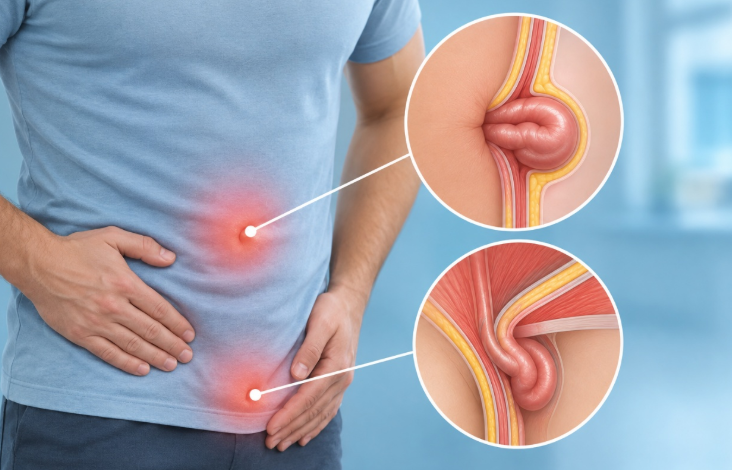
An inguinal hernia develops in the groin area when abdominal tissue protrudes through a weakened section of the inguinal canal.
It is the most common type of hernia and occurs approximately five times more frequently in men than in women.
Several factors contribute to its development, including weakened abdominal tissues, obesity, pregnancy, chronic coughing, constipation, and increased abdominal pressure during strenuous physical activity.
Common Symptoms of an Inguinal Hernia
The most recognizable symptom is a visible bulge in the groin, particularly when standing, coughing, or lifting heavy objects.
Patients may also experience discomfort, burning sensations, pain, or pressure in the affected area.
In men, swelling and discomfort may extend toward the scrotum. However, some inguinal hernias remain asymptomatic and are discovered during routine medical examinations.
What Is an Umbilical Hernia?
An umbilical hernia occurs when abdominal tissue protrudes through an opening near the navel, creating a noticeable bulge.
This condition affects both infants and adults. In adults, contributing factors include obesity, multiple pregnancies, ascites, and previous abdominal surgery.
Common symptoms include swelling around the navel, abdominal discomfort, pain, digestive disturbances, and a feeling of heaviness.
Potential Complications of Hernias
Both inguinal and umbilical hernias can lead to serious complications when left untreated.
One significant complication is strangulation, which occurs when trapped abdominal tissue loses its blood supply.
This condition may cause severe pain and tissue damage, requiring immediate surgical intervention.
Therefore, medical evaluation is important even when a hernia causes minimal discomfort.
Modern Surgical Treatment Options
Surgery is the primary treatment for repairing inguinal and umbilical hernias.
Traditional open surgery involves repositioning the protruding tissue and reinforcing the weakened abdominal wall, usually with surgical mesh.
Laparoscopic hernia repair offers a minimally invasive alternative, using small incisions to reduce postoperative discomfort and support faster recovery.
For umbilical hernias, the advanced e-TEP (RS) technique allows surgeons to position surgical mesh behind the abdominal muscles without requiring fixation.
Robotic-assisted surgery provides additional advantages, including improved visualization, greater precision, and enhanced flexibility during complex surgical procedures.
The most appropriate surgical approach depends on the hernia’s characteristics and the patient’s individual medical needs.
Specialized Hernia Treatment
Choosing an experienced surgeon is an important part of effective hernia management.
Dimitrios Gialvalis, a specialized hernia surgeon with extensive experience in laparoscopic and robotic surgery, provides individualized assessment and surgical treatment.
For further information about inguinal hernias, umbilical hernias, and modern surgical repair techniques, patients can contact Dimitrios Gialvalis