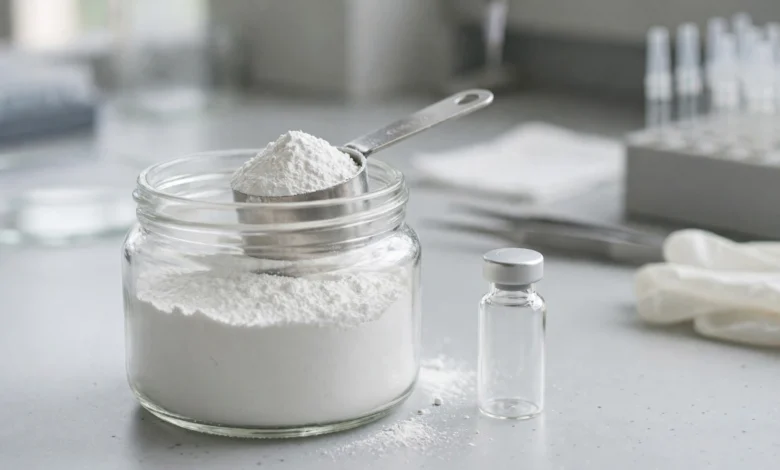
Collagen peptides and BPC-157 share a word and very little else. Collagen peptides are a food supplement, a mix of protein fragments made by breaking down collagen from cattle, pigs or fish. BPC-157 is one specific, lab-made chain of 15 amino acids, and it has no approval as a drug.
The confusion is understandable. Chemically, a peptide is any short chain of amino acids, so the label fits both. It just describes them very differently.
What are collagen peptides?
Start with collagen itself. Scientists have identified nearly 28 types. Its chains are built on a repeating glycine, X, Y pattern, with proline and hydroxyproline in those X and Y spots. A 2019 review in Molecules puts glycine at about 33% of the protein, and proline and hydroxyproline together at about 22%.
Collagen peptides, also sold as hydrolyzed collagen, are what you get when enzymes such as papain, pepsin or alcalase cut those long chains into pieces. Most commercial material comes from cows or pigs, with marine sources such as fish skin and scales gaining ground.
The key word is mix. A scoop of collagen peptides holds many different fragments of different lengths, and the review describes them as a group of low-molecular-weight peptides in the range of 3 to 6 kilodaltons.
What is BPC-157?
BPC-157 is a single molecule. Its 15 amino acids always run in the same order, Gly-Glu-Pro-Pro-Pro-Gly-Lys-Pro-Ala-Asp-Asp-Ala-Gly-Leu-Val, a sequence taken from a protein found in human gastric juice. It is made synthetically and weighs 1,419.56 g/mol.
- That makes for an odd twist. A typical collagen peptide, at 3,000 to 6,000 daltons, is roughly two to four times heavier than BPC-157.
- Collagen peptides
- BPC-157
- What it is
- A mix of collagen fragments
- One defined sequence
- Size
- Mostly 3 to 6 kDa
- 15 amino acids, about 1.4 kDa
- Source
- Bovine, porcine or marine collagen
- Chemical synthesis
- Usual forms
- Powders, drinks, capsules
- Freeze-dried powder in vials
- US status
- Dietary supplement
- Not FDA approved
- Main evidence
- Human skin trials, mixed results
- Animal and cell studies
How are they regulated?
Collagen peptides sell as dietary supplements. In the US, the Dietary Supplement Health and Education Act of 1994 sets the rules, and under it the FDA has no authority to approve supplements before they reach the market. Manufacturers carry the first responsibility for safety and for backing up their label claims.
BPC-157 sits in a different category. It has no FDA approval for any use. In July 2026, an FDA advisory committee on pharmacy compounding voted 8 to 6, with one abstention, to recommend adding it to the list of substances pharmacies may compound, ABC News reported. The vote is advisory, and the agency still has to decide. Sport has its own rule, and the World Anti-Doping Agency has listed BPC-157 as prohibited since 2022.
It also turns up in blends, as one half of the Wolverine peptide stack, which pairs it with TB-500 in one vial. Sellers now offer BPC-157 vials and capsules, though no published human study has characterized an oral product.
What does the evidence show?
The collagen evidence is human and contested. A 2025 meta-analysis in The American Journal of Medicine pooled 23 randomized trials with 1,474 participants and found improvements in skin hydration, elasticity and wrinkles across all of them. In the trials without pharmaceutical funding, the effect disappeared, and the high-quality trials showed no significant effect, which led the authors to conclude there is currently no clinical evidence to support collagen supplements for preventing or treating skin aging.
BPC-157's record is mostly animals and cells. A 2025 systematic review in the HSS Journal found the orthopedic and sports literature almost entirely preclinical. A phase 2 trial in acute hamstring strain, NCT07437547, is recruiting.
FAQs
Is collagen a peptide?
Collagen is a large protein. Collagen peptides are the short fragments left after it is broken down.
Is BPC-157 made from collagen?
No. Its sequence comes from a protein in gastric juice, and it is built from scratch in a lab.
Are collagen peptides and BPC-157 regulated the same way?
No. Collagen peptides are sold as dietary supplements. BPC-157 has no FDA approval.
Sources
- León-López A, Morales-Peñaloza A, Martínez-Juárez VM, et al. Hydrolyzed collagen: sources and applications. Molecules, 2019.
- U.S. Food and Drug Administration. Questions and answers on dietary supplements.
- Salzman S, Kekatos M. FDA advisory committee votes to add popular peptide BPC-157 to drug compounding list. ABC News, July 23, 2026.
Myung SK, Park Y. Effects of collagen supplements on skin aging: a systematic review and meta-analysis of randomized controlled trials. The American Journal of Medicine, 2025.
Vasireddi N, Hahamyan H, Salata MJ, et al. Emerging use of BPC-157 in orthopaedic sports medicine: a systematic review. HSS Journal, 2025.