Why cockroaches keep gathering in the same places, and how to use that against them

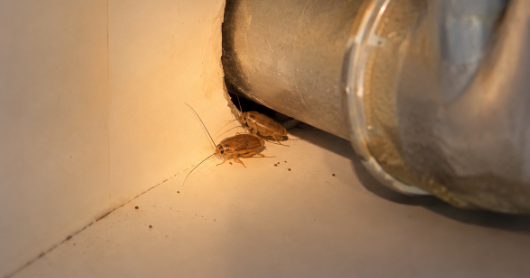
In short. German cockroaches don’t spread evenly through a kitchen. They cluster in a few hotspots close to warmth, water and food, and research shows their droppings carry chemical signals that draw others to the same places. That behaviour gives treatment a clear target. Ghilotina, a range of pest control products for professional and household use, follows a logical sequence built around it: find the hotspots, clear away the signals, treat in a targeted way, then check the result. No method can promise to clear every infestation, but working step by step makes it less likely that a hotspot is missed. What are the signs of a cockroach hotspot?
- Clusters of droppings: black specks, like ground pepper, concentrated in one corner, hinge or shelf.
- Dark smudges: brownish marks along edges and gaps where cockroaches rest and pass.
- Egg cases and shed skins: brown capsules and pale empty skins near the same spot.
- A stronger smell in one place: a stale, oily odour in one cupboard more than the others.
- Repeat sightings: insects scattering from the same place each time you switch on the light at night.
Where to look: behind the fridge and dishwasher, under the sink, around the oven, in cupboard corners and hinges, and around pipes.
Why do cockroaches gather in the same spots?
Because their droppings tell other cockroaches where to go. Entomologists at NC State University (Wada-Katsumata et al., PNAS, 2015) found that German cockroach droppings release chemical signals that attract other cockroaches and encourage them to stay. The team identified 40 such compounds and showed that bacteria in the insects’ gut play a key role in producing them.
In practice, a hotspot keeps advertising itself for as long as the droppings stay there.
Why does cleaning up droppings matter?
Because removing them takes away part of that signal. Before you treat:
- Vacuum droppings, skins and debris from corners, hinges and the areas behind appliances, then seal the vacuum bag and throw it away outside.
- Wipe the surrounding surfaces with a detergent.
- Do this deep clean before treatment. Afterwards, avoid washing the spots where bait has been placed.
What do cockroaches need to survive in a kitchen?
Above all, water and warmth.
- Water: in a study published in the Japanese journal Pestology, young German cockroach nymphs died within about three weeks without food and water, while older ones survived up to seven weeks. Fix drips, dry the sink and draining board at night, and don’t leave water standing.
- Warmth: University of Florida entomologists note that cold is the main factor limiting the species’ survival. Indoors, they favour warm spots near appliance motors, boilers and hot pipes, so check those first.
How do you find the hotspots?
With monitoring traps, placed where you suspect activity and checked often.
- Ghilotina’s t180 Hot Spot: a folding cardboard glue trap with a food attractant built into the adhesive. Place it as close as possible to the suspected source, flat or upright.
- t225 Hot Spot Plus: a larger glue trap with four entry points and an attractant tablet placed in the centre.
The traps that catch the most show you where to treat. Replace them once the adhesive is covered, and keep a few in place after treatment to check the result.
What is the core treatment, and what can you add?
The base, in most kitchens
- i21.5 Premise Gel: a gel bait applied in small spots of about 0.1 g, roughly 7 mm across, out of sight and between hiding places and food sources. Avoid dusty, damp, greasy or freshly washed surfaces.
- s7 Insect Box: an empty bait station that you fill with gel. It is useful in visible spots or where you’d rather the bait didn’t touch the surface directly. Refill it as the label of the gel indicates.
A complementary option
- i0.25 Super RTU: a ready-to-use residual spray for hard surfaces, cracks and edges where cockroaches travel. Keep it away from the bait spots and stations, and keep people and pets out of the room until it has dried and the space has been ventilated.
In the Ghilotina range, both the gel and the spray are marked for household as well as professional use. If activity continues after a full round of treatment, or spreads beyond the kitchen, call a pest control professional.
How does Ghilotina fit in?
Ghilotina is a range of pest control products for professional and household use. The brand’s cockroach guide, this practical guide, sets out the same sequence in more detail: monitoring with traps, gel baits and bait stations, ready-to-use treatments and preparation of the space.
One buyer’s comment on the product page:
- “Useful product to avoid direct contact of substances with possible more sensitive surfaces.” Flaviu, 17 March 2019, on s7 Insect Box
| CATEGORY | WHAT IT DOES | PRODUCTS |
| Find the hotspots | Locate and count activity | t180 Hot Spot, t225 Hot Spot Plus |
| Core treatment | Gel bait between hiding places and food | i21.5 Premise Gel, s7 Insect Box |
| Complementary option | Residual spray on surfaces, away from bait | i0.25 Super RTU |
| Guide and follow-up | Order of steps, regular checks | Cockroach guide on the website |