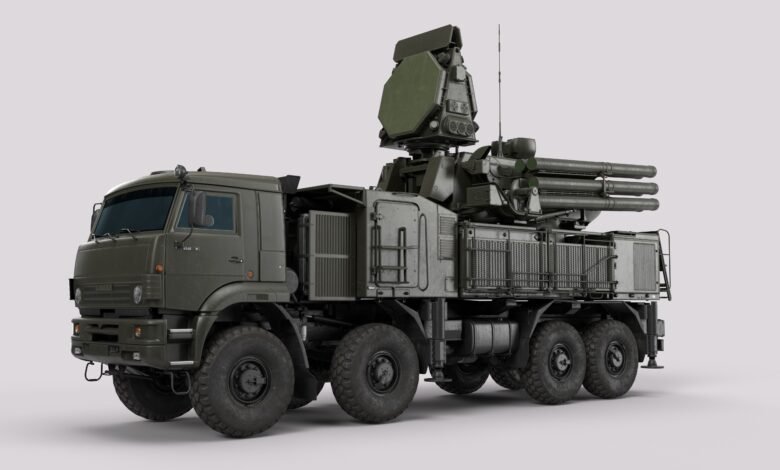
When you think about defense technology, your mind probably jumps to drones, hypersonic systems, or AI-assisted targeting. Yet some of the most critical decisions still come down to a tiny physical component: the switch. In missile and munitions platforms, switch design affects safety, usability, maintenance, and mission reliability. If you want to understand how military hardware actually performs under pressure, looking closely at switch engineering gives you a surprisingly clear view.
The smallest hardware can carry the biggest consequences
A missile switch is not just a button that turns something on or off. In defense platforms, it often acts as a control point for arming, release authorization, launch sequencing, or environmental isolation. One weak tactile response, one seal failure, or one misread position can create a chain of problems no software patch can fix.
You can see the logic in systems built for mission-critical use, including Select Controls missile switches, which are designed for missile, rocket, and munitions applications where durability and precise actuation matter. In these environments, operators may be wearing gloves, working in vibration-heavy conditions, or responding under severe time pressure. A control interface has to remain unmistakable, even when the human using it is physically strained or cognitively overloaded.
Harsh environments change what good design looks like
Consumer electronics train you to expect smooth touch surfaces and minimal force inputs. Military hardware plays by different rules. Missile systems may face shock loading, salt exposure, thermal cycling, sand intrusion, moisture, and electromagnetic interference. A switch that feels outdated in a phone-like interface can be exactly what you need in a launch or weapons-control setting.
That changes how you judge quality. Engineers look at ingress protection, contact reliability, materials compatibility, vibration tolerance, and life-cycle performance under repeated stress. The ideal switch is not the flashiest part on the panel. It is the one that keeps working after transport, storage, deployment, and rough handling. If a platform sits dormant for long periods, then gets activated in a high-stakes moment, dormant reliability becomes just as important as active reliability.
Human factors engineering matters more than people expect
You might assume missile controls are mainly about internal electronics and ordnance integration. Human factors sit right beside them. Switch placement, travel distance, guard geometry, detent feel, and visual identification all shape how an operator interacts with the system. In a combat or test setting, small ergonomic choices can reduce hesitation and prevent wrong-input events.
Think about the difference between a flat toggle and a guarded switch with a distinct throw force. One can be brushed accidentally. The other requires intentional movement. That distinction matters when an interface includes arming, jettison, or launch-related functions. Defense contractors spend serious time mapping how operators behave under stress because real use rarely looks like the neat assumptions made in design software. Interface friction, when applied correctly, can be a safety feature rather than a flaw.
Safety architecture is built into the hardware, not added later
People often talk about defense safety in software terms: permissions, interlocks, validation layers. Physical hardware still carries a huge share of that burden. Missile switch design often incorporates guarded covers, multi-step actuation, clear state indication, and mechanical resistance to accidental activation. Those elements support the broader safety architecture of the weapons system.
That matters during transport, maintenance, and storage just as much as during operation. A switch may need to remain secure through logistics chains, repeated inspections, and environmental exposure before it ever reaches a live scenario. If hardware controls are ambiguous, then maintenance crews, ground support staff, and operators all inherit more risk. Good safety engineering reduces interpretation. You should be able to tell, quickly and confidently, what state the control is in and what action it permits.
Supply chain pressure has made component selection more strategic
Over the last few years, defense manufacturing has faced tighter scrutiny around sourcing, qualification, lead times, and lifecycle support. Components that once looked interchangeable no longer feel interchangeable when procurement delays affect testing schedules or platform readiness. Switches sit inside that larger reality.
For integrators and program managers, the question is no longer only whether a part meets spec on paper. You also need to know whether it can be consistently sourced, documented, validated, and supported over time. Military and aerospace systems are not built around frequent redesign for convenience. A seemingly small component change can trigger qualification headaches, documentation revisions, and integration delays. In that environment, stable engineering support and application-specific manufacturing become operational concerns, not just purchasing preferences.
Testing reveals problems that spec sheets tend to hide
A datasheet can tell you electrical ratings, operating force, and material details. It tells you far less about how a switch behaves after repeated shock events, long idle periods, contamination exposure, or use by different operators in field conditions. Real validation usually comes from qualification testing, system integration testing, and maintenance feedback.
This is where defense hardware separates itself from general industrial hardware. It is not enough for a switch to function in isolation on a bench. It has to perform inside the actual enclosure, under the actual vibration profile, with the actual wiring harness, while supporting the exact operational sequence the platform requires. You learn quickly that component reliability is contextual. A switch can be technically sound and still be a poor fit if the actuation profile or mounting configuration creates avoidable operational risk.
Modernization does not eliminate the need for physical controls
As defense systems become more digitized, some people assume physical switches will fade into the background. That has not happened. In many cases, digitization raises the value of dependable physical controls because operators need trusted, immediate inputs that work independently of complex interface layers. A missile system can include advanced electronics, sensor fusion, and software-defined behavior while still depending on rugged hardware at the human-machine boundary.
You can see this across aerospace and defense design more broadly. The best modern systems do not treat hardware and software as rivals. They divide responsibilities carefully. Software handles adaptability, data processing, and logic management. Physical controls handle deliberate action, tactile confirmation, and durable interface reliability. If you are evaluating where mission assurance really comes from, that pairing deserves more attention than it usually gets.
Looking at switch design gives you a clearer picture of defense readiness
It is easy to talk about strategic capability in abstract terms. It is harder, and more useful, to look at the parts that must perform without excuses. Missile switch design sits in that category. It connects safety doctrine, operator behavior, manufacturing quality, and system integration in one compact piece of hardware.
If you want to understand whether a defense platform is truly ready, pay attention to components that seem minor at first glance. They often reveal the discipline of the entire program. A reliable switch does not make headlines, yet it reflects serious engineering choices about failure tolerance, usability, and mission execution. In defense systems, readiness is rarely built from dramatic breakthroughs alone. It is also built from small controls that keep doing exactly what they were designed to do.