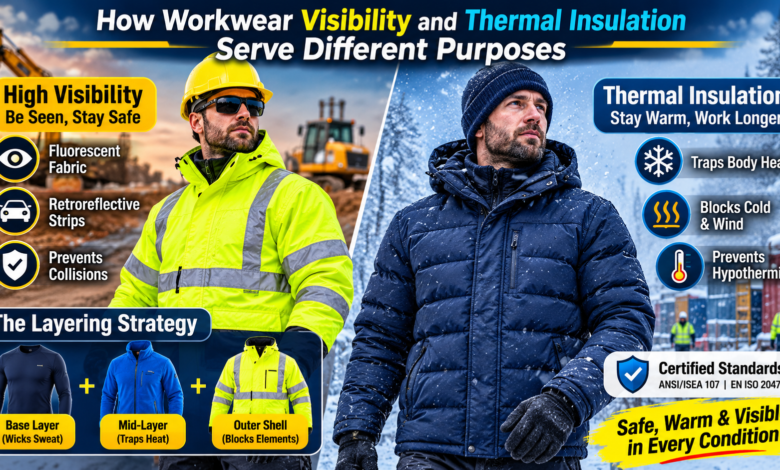
Managing workplace safety across dynamic civil construction corridors, active rail spurs, container shipping docks, and airport transit aprons requires balancing multiple environmental defenses simultaneously. When field personnel execute their duties in exposed industrial settings, they frequently confront dual hazards: reduced visual detection by heavy equipment operators and rapid physiological heat loss caused by sub-zero ambient temperatures. Assuming that a single standard garment can automatically satisfy both requirements without careful engineering often leads to critical operational failures, such as diminished reaction buffers on job sites or rapid physical exhaustion due to restrictive, sweat-trapping layers.
Examining high visibility vs insulated workwear reveals that conspicuity and thermal preservation address completely distinct physical challenges. High-visibility apparel operates in the domain of optics, colorimetry, and human visual perception to prevent struck-by collisions, while thermal insulation functions through thermodynamics, fiber morphology, and boundary-layer mechanics to prevent hypothermia and cold stress.
Optical Conspicuity Mechanics on Industrial Job Sites
The fundamental purpose of high-visibility clothing is guaranteeing rapid visual recognition from safe braking distances across all lighting conditions. When ground crews navigate crowded staging areas alongside reversing wheel loaders, articulated haulers, and passing civilian motorists, optical contrast directly dictates operator response times. Standard dark utility uniforms blend into grey asphalt, damp soil, and shadowed industrial machinery, reducing human silhouettes to obscure background noise.
To prevent blind-spot collisions, certified workwear utilizes the science of photoluminescence. Fluorescent clothing technology relies on specialized chemical pigments embedded in polyester or nylon fibers that absorb invisible ultraviolet radiation from natural daylight and re-emit that energy across specific, intense visible wavelengths. This molecular energy shift creates a vibrant visual radiance that stands out to the human eye, particularly during overcast dawn, dense coastal fog, and late dusk when ambient daylight is weak.
Equipping ground personnel with a certified wholesale high-visibility jacket surrounds the torso and arms with this specialized optical material, establishing an unmistakable contrast profile against complex visual backgrounds throughout daytime operations.
Complementing this daytime fluorescence, retroreflective workwear materials manage visibility in complete nocturnal darkness. Standard surfaces scatter light in multiple directions, bouncing vehicle headlights away from the driver. Retroreflective bands utilize millions of microscopic high-refractive glass spheres or micro-prismatic synthetic facets that capture incoming headlamp beams and redirect that light directly back to the vehicle operator’s line of sight, outlining the worker as an illuminated figure against the dark.
The Thermodynamics of Dead Air and Thermal Insulation in Jackets
While optical elements protect against external moving machinery, thermal insulation protects against the invisible physical drain of environmental cold. When personnel work in sub-freezing temperatures, the human body constantly radiates heat into the colder surroundings through conduction and convection. Uninsulated fabrics allow moving wind drafts to strip away the warm boundary layer of air that human metabolism naturally produces around the torso, triggering peripheral vasoconstriction, shivering, reduced grip strength, and impaired cognitive focus.
Thermal insulation counters this heat loss by immobilizing air within an expansive, low-density fiber matrix. Dry, stationary air possesses exceptionally low thermal conductivity. When synthetic polyester batting or down clusters are positioned between a garment’s shell and lining, they create millions of microscopic dead-air chambers where air molecules cannot circulate freely. By halting internal convective currents, the garment traps body heat close to the skin.
Integrating a high-loft wholesale puffer jacket into a cold-weather workwear program provides field workers with an efficient thermal shield that preserves internal core temperatures during stationary duties or sub-zero staging shifts without adding exhausting physical weight.
Pairing dedicated thermal insulation with durable outer shells ensures that crews remain warm, mentally sharp, and physically capable throughout long, grueling outdoor shifts.
Regulatory Standards for Industrial Visibility
To ensure job-site safety is never left to guesswork, workplace safety regulators enforce rigorous high-visibility clothing standards, including ANSI/ISEA 107 in North America and EN ISO 20471 across global territories. These guidelines mandate precise minimum square inches of fluorescent background textiles and retroreflective striping based on the speed of adjacent vehicular traffic and operational risk tiers.
Class 1 garments provide baseline recognition in controlled environments where vehicular equipment does not exceed twenty-five miles per hour, such as indoor warehouse logistics and enclosed freight terminals.
Class 2 garments are required for operations where traffic moves between twenty-five and fifty miles per hour, making them standard mandatory PPE for railway maintenance crews, municipal utility technicians, and roadway survey personnel.
Class 3 garments deliver maximum conspicuity for high-hazard zones where machinery and vehicular traffic exceed fifty miles per hour, such as night-time interstate paving, emergency storm restorations, and structural bridge work. These designs require continuous reflective striping across the torso, shoulders, and full sleeves to ensure a 360-degree human silhouette is immediately identifiable from extensive distances.
The Strategy of Layering for Outdoor Workers
In dynamic field environments, cold weather workwear principles require an adaptable, multi-piece system rather than relying solely on one massive, heavily insulated coat. Outdoor personnel frequently shift between periods of high physical exertion, such as rigging steel or carrying materials, and prolonged sedentary periods, such as operating crane controls or waiting on transport.
Wearing an all-in-one heavy coat during vigorous physical labor causes rapid perspiration. If sweat vapor cannot escape the garment, it saturates inner shirts, collapsing their thermal efficiency and causing severe evaporative chilling the moment work stops.
To prevent this dangerous moisture trap, forward-thinking safety managers implement a modular layering approach:
An inner base layer engineered from hydrophobic synthetic yarns sits directly against the skin to pull liquid sweat away from the body before it causes chills.
A breathable intermediate mid-layer, such as a fleece pullover or lightweight insulated vest, traps core heat without restricting arm motion or shoulder flexibility.
An outer high-visibility shell provides environmental defense, blocking wind and rain while displaying certified fluorescent fabric and retroreflective striping to keep the worker safe around moving equipment.
This modular structure allows workers to shed or adjust mid-layers as ambient temperatures and exertion levels rise, maintaining continuous safety compliance on the exterior while regulating internal body heat.
Manufacturing Standards and Supply Discipline
Producing industrial outerwear that combines optical compliance with thermal performance requires strict quality assurance and raw material consistency. High-visibility fabrics must retain their fluorescent chroma under continuous ultraviolet exposure, and reflective striping must withstand abrasive grit, mechanical grease, and repetitive industrial laundering without cracking or delaminating.
Suppliers like Simplstc Apparel utilize these performance-driven production techniques to build durable, minimalist outerwear that balances high-efficiency insulation with modern casual styling. Accessing professional technical lines through platforms such as simplstcapparel.com demonstrates how thermal engineering, clean pattern tailoring, and high-tenacity shell materials can come together to keep wearers comfortable without the excessive weight and bulk of traditional winter garments.
Carefully inspecting seam welding, pocket bar-tacking, and heavy-duty front zippers ensures that workwear withstands the punishing conditions of heavy commercial job sites.
Building a Safe and Resilient Workforce
High-visibility design and thermal insulation serve distinct, indispensable roles in keeping outdoor workers protected. Conspicuity engineering ensures that personnel remain visible to equipment operators in chaotic, low-light environments, while thermal insulation protects the body from the dangerous physical toll of freezing temperatures.
By understanding how optical materials, dead-air trapping, and modular layering systems work together, safety directors can create a comprehensive workwear strategy that keeps field personnel safe, warm, and productive across every demanding job site.