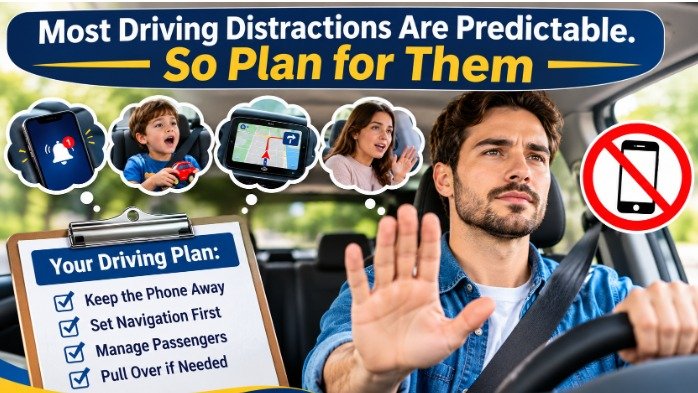
Think about the last few times your attention slipped behind the wheel. A phone lit up. The navigation rerouted. A kid in the back seat dropped a toy or announced they were hungry. A passenger said, “Hey, look at this.” None of it was a real surprise. Interruptions like these come in familiar shapes, which means you can decide ahead of time what you’ll do when they show up.
That’s the idea behind effective distracted driving prevention: fewer decisions made in the moment and more made in the driveway. It’s less about heroic willpower and more about arranging the drive so the right choice is also the easy one. Here’s how that works, what the research does and doesn’t say, and how to put it into practice.
Most Interruptions Aren’t Surprises
Researchers at Monash University’s Accident Research Centre put cameras in the cars of 12 Australian families with children aged one to eight and analyzed 92 trips. Ninety of the 92 included a potentially distracting activity tied to the children. On average, parents looked away from the road for about three minutes and 22 seconds of a 16-minute trip, most often to turn toward the back seat or check on a child in the mirror. The sample was small and the study was Australian, so don’t read the numbers as US averages. The pattern is still useful. The distractions were frequent, ordinary and foreseeable. Nobody was caught off guard when a toy hit the floor.
Phones follow the same logic: a buzz, a banner, a reroute, a nagging itch to check. They aren’t random. They’re the same handful of triggers, over and over.
Willpower Is a Poor Plan
Resisting in the moment means making a decision while you’re already managing speed, traffic and other drivers. Good intentions often lose that contest. Psychologists have studied a simple alternative called an implementation intention: an if-then plan that links a specific situation to a specific response, decided in advance.
In a randomized controlled study by Elliott and colleagues (Transportation Research Part F, 2021), drivers assigned to form such plans used their phones less in the specific situations they had planned for, but not in situations they hadn’t named. A 2025 randomized trial of a worksheet meant to encourage these plans found no overall reduction in phone use, although participants who stuck closely to their plans did seem to use their phones less while driving. The lesson is modest and useful. Plans help when they’re specific, remembered and used. They aren’t a magic trick, and a vague resolution like “I’ll be more careful” isn’t a plan.
Write the If-Then Plans
Pick the interruptions you actually face and give each a response. Plans are what turn distracted driving prevention from a slogan into a habit. A few examples:
- If the phone buzzes, then I leave it until my next stop.
- If the navigation reroutes, then I follow the voice prompt, and if I want to change the destination, I pull over first.
- If a passenger says “look at this,” then I say “show me when we stop.”
- If a child needs something, then I answer by voice and fix it at the next safe stop, or pull over if it can’t wait.
- If I feel the urge to check at a red light, then my phone stays untouched and I watch the light.
Keep each plan short enough to remember, since the 2025 trial hints that how well people hold onto their plans matters. Say them out loud once. Write them on a sticky note for the visor if that helps. The goal isn’t a rulebook. It’s to make the next interruption feel like something you’ve already handled.
Shape the Car So the Plan Is Easy
A plan is easier to keep when the car isn’t working against it. Before you pull out:
- Eat or grab your drink first.
- Give children what they’ll need: a snack, water, a toy within reach, something to do.
- Make sure children are properly buckled and settled. Reports on the Monash study said children were in an incorrect position for much of the trip time, a reminder that settling kids isn’t just a formality. It likely affects how often you turn around.
- Put the phone where you can’t grab it from the driver’s seat.
- Set the route and the audio before the car moves.
Most of good distracted driving prevention is this kind of setup. Every item you handle in the driveway is a decision you won’t face at 55 miles an hour.
Tell Your Passengers the Plan
Passengers can be your best protection or another source of distraction, and they can’t help if they don’t know what you need. Say it before you go: “I’m not going to look at anything while we’re moving. Ask me and I’ll answer when we stop.” Name a co-pilot who handles directions, music and replies. Set ground rules with children before the car starts, and expect them to be forgotten, which is why the pull-over plan matters.
Don’t assume another adult in the car solves it. In the Monash study, the presence of a front-seat passenger did not significantly change how often or how long drivers dealt with child-related activities. Say what you want the other person to do.
Where Technology Fits
Technology can back up a plan, but the plan comes first. Tools that fall under the heading of safe driving technology, such as settings or apps that hold notifications while the car is moving, can remove one trigger from your list. They can’t answer a passenger’s question, soothe a restless child or tame your own urge to check. Treat them as a second line of defense for a routine you’re already running, and check what any tool actually covers, since coverage varies by device, operating system and app.
Plan the Drive, Then Drive the Plan
Predictable interruptions deserve predictable responses. Choose your triggers, write short if-then plans, set up the car and your passengers before the key turns, and use technology as backup. Done well, distracted driving prevention is mostly planning that happens before the trip, and it asks far less of your willpower than trying to resist everything in the moment. My Drive Guardian, which includes distracted-driving tools among its features, is one example of technology that can support that routine, but the routine itself is yours.