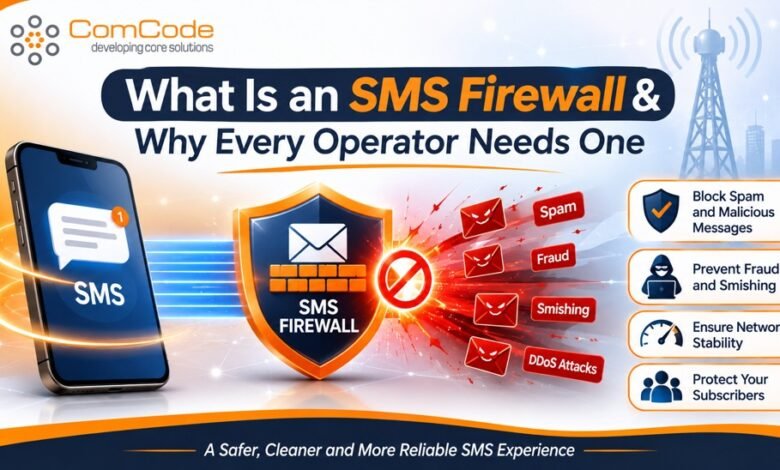
An SMS Firewall is a security system that sits in a mobile operator’s network & inspects, filters & controls every SMS entering or leaving it. Every operator needs one because, without it, spam, spoofing, fraud & grey-route traffic drain revenue & erode subscriber trust.
Introduction
SMS is still one of the most trusted channels for banking alerts, one-time passwords & customer notifications. That trust makes it a prime target for abuse. Operators that leave their messaging network unprotected lose money & put their subscribers at risk.
In this guide, brought to you by Comcode Tech, we explain what an SMS Firewall is, the threats it stops, how it works & how to choose the right deployment model.
What Is an SMS Firewall?
An SMS Firewall is a dedicated platform that analyzes SMS traffic in real time & decides whether to allow, block, reroute or flag each message. It typically sits between external traffic sources (international carriers, aggregators, bulk senders) & the operator’s SMSC inside the telecom core network.
It is different from a basic spam filter. A spam filter checks message content. An SMS Firewall also examines the traffic source, routing path, sender identity, signaling data & sending behavior, so it can catch attacks that content filtering misses.
The Threats Operators Face Today
- A2P messaging fraud & grey routes. Application-to-person (A2P) messages are sent by businesses to customers. Some a2p messaging providers route this traffic through cheap, unofficial paths, often disguised as person-to-person (P2P) traffic, to avoid paying proper termination rates. The operator delivers the messages but earns little or nothing.
- SMS spoofing & smishing. Attackers fake sender ID’s to impersonate bank’s, delivery companies or government agencies & trick subscriber’s into sharing credentials or clicking malicious link’s.
- SMPP abuse. SMPP is the protocol that carries most bulk & A2P traffic. Unauthorized connections, credential misuse & traffic floods through an smpp gateway can overload systems & push spam into the network.
- SIGTRAN & SS7 attacks. Legacy signaling protocols, carried over SIGTRAN in modern networks, were not built with strong authentication. Attackers can exploit them to intercept messages (including OTPs), track subscriber locations or inject fake messages.
The result is lost revenue, frustrated subscribers, brand damage & possible regulatory penalties.
How an SMS Firewall Work’s
Traffic flows through the firewall before reaching the SMSC & the subscriber:
Source → SMS Firewall → SMSC → Subscriber
Core functions include:
- Sender ID validation: detects spoofed or unregistered sender names.
- Content & pattern analysis: flags phishing link’s, spam keyword’s & repeated message patterns.
- Rate limiting: stop’s flood’s from a single source or connection.
- Home-routing & signaling check’s: hide subscriber identifier’s (such as IMSI) & block unauthorized SS7/SIGTRAN request’s.
- Grey-route detection: identifies A2P traffic masquerading as P2P & redirects it to monetized, legitimate route’s.
- Blacklists & whitelist’s: allow or deny known sources instantly.
- Real-time analytics: dashboard’s & reports show traffic trend’s, blocked threats & recovered revenue.
Key Benefit’s for Operator’s
- Revenue recovery: convert grey-route traffic into billable A2P traffic.
- Subscriber protection: fewer spam, phishing & fraud message’s reach customer’s.
- Regulatory compliance: many regulator’s now expect operator’s to control SMS abuse & protect subscriber data.
- Stronger partnerships: legitimate A2P messaging provider’s prefer network’s with clean, well-managed traffic.
- Brand reputation: a trusted messaging channel keep’s customer’s loyal.
Key Features to Look For
- Support for both SMPP & SS7/SIGTRAN traffic
- Real-time detection using rule-based & machine-learning engines
- Scalability for peak traffic, such as holiday’s & promotion’s
- Flexible, easy-to-update filtering rule’s
- Detailed reporting & alerting
- Smooth integration with existing core network element’s
- Regular threat-intelligence update’s
In-House vs. Managed SMS Firewall Solution
| Factor | In-House | Managed Solution |
| Upfront cost | High (hardware, licenses, staff) | Lower, often subscription-based |
| Expertise needed | Dedicated security & telecom team | Provided by the vendor |
| Deployment speed | Slow | Faster |
| Threat updates | Handled internally | Continuous |
| Monitoring | Must build 24/7 coverage | Typically included |
A managed sms firewall solution suits operators & MVNOs that want fast protection without building a specialist team. Large operators with mature security operations may prefer in-house control, though many choose a hybrid approach.
Implementation Best Practice’s
- Assess your traffic: audit current SMS flows to find vulnerabilities, grey routes & revenue leakage.
- Define policie’s: set clear rule’s & thresholds for filtering, blocking & rerouting.
- Roll out in phase’s: start in monitoring mode, review result’s, then move to active blocking to avoid blocking legitimate traffic.
- Tune continuously: attacker’s adapt so review rule’s & report’s regularly.
- Involve stakeholders: align security, revenue assurance & partner management teams.
Frequently Asked Questions
- What is the difference between an SMS firewall & a spam filter?
Ans. A spam filter checks message content. An SMS Firewall also checks the source, route, sender identity & signaling, giving much broader protection.
Does an SMS firewall stop grey routes?
Yes. It detects A2P traffic disguised as P2P & redirects it to legitimate, billable routes.
Can small operators benefit from a managed solution?
Absolutely. A managed model removes the need for in-house expertise & large upfront investment.
How long does deployment take?
It depends on network complexity & scope, but managed deployments are generally faster than in-house builds.
Conclusion
An SMS Firewall is no longer optional. It protects revenue, blocks fraud, secures signaling & preserves the subscriber trust that SMS depends on. Whether you build in-house or choose a managed model, acting early costs far less than recovering from a major abuse incident.
Comcode Tech offers end-to-end Telecom Consultancy Services to help operators assess risks, design the right architecture & deploy an effective SMS Firewall.