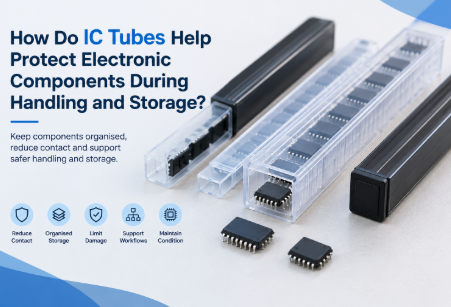
IC tubes help protect integrated circuits and other electronic components during handling, storage and movement by keeping them organised and reducing direct contact between components. They can also make it easier to transfer components between production, inspection and assembly stages. For electronics manufacturers, choosing suitable IC tube packaging solutions in India can help meet specific packaging, storage and handling requirements.
The right IC tube depends on component dimensions, packaging design, handling conditions and any electrostatic discharge (ESD) protection requirements. Understanding these factors helps businesses select suitable electronic component packaging tubes for their production processes.
How Do IC Tubes Protect Electronic Components?
IC tubes are narrow packaging containers designed to hold electronic components in an organised arrangement. They are commonly used in electronics manufacturing and component handling processes where parts need to be stored, moved or supplied for assembly.
Depending on their design and the components they hold, IC tubes can help protect parts in several ways.
- Reduce direct contact. Keeping components separated can reduce contact between parts during handling.
- Support organised storage. Tubes help keep components together and make them easier to identify, count and manage.
- Limit handling damage. Suitable packaging can reduce unnecessary movement and contact during routine transfers.
- Support production workflows. Tubes can make it easier to move components between storage, inspection and assembly areas.
- Help maintain component condition. Appropriate packaging can reduce exposure to some handling-related risks, depending on the tube design and storage environment.
IC tubes do not provide the same level of protection in every situation. Their effectiveness depends on the material, dimensions, fit, closures and handling methods used.
Why Are IC Tubes Used for Handling and Storage?
Electronic components can be small, delicate and difficult to manage in large quantities. Loose storage may increase the chance of misplaced parts, unwanted contact or handling errors.
IC packaging tubes provide a structured way to store and move components through manufacturing operations.
Easier component handling
Keeping components in a dedicated tube can reduce the need to handle individual parts repeatedly. This can be useful when components move between production stations or are supplied to assembly equipment.
The tube dimensions must suit the components to help prevent excessive movement or a poor fit.
Better storage organisation
IC tubes help keep components grouped together. Businesses can organise tubes by component type, size, batch or production order, depending on their inventory system.
This can make it easier for staff to locate parts and prepare them for use.
Reduced risk of physical damage
Components may be damaged if they collide with other parts, fall during handling or are stored in unsuitable packaging. A properly selected IC tube can help limit these risks by holding components in a controlled arrangement.
However, the tube should be suitable for the component’s shape and size. Incorrect dimensions or unsuitable handling may still cause damage.
What Is the Difference Between Standard IC Tubes and Anti-Static IC Tubes?
One important consideration when selecting electronic component packaging tubes is whether the components are sensitive to electrostatic discharge.
Electrostatic discharge occurs when built-up electrical charge moves suddenly between objects or surfaces. This discharge can damage some electronic components, even when the damage is not visible.
Standard IC tubes
Standard tubes may be suitable for components that do not require specialised ESD protection, provided the packaging meets the application’s other requirements.
However, a tube should not be assumed to provide ESD protection simply because it is made from plastic or is used for electronics packaging.
Anti-static and ESD packaging tubes
Anti-static or ESD-related packaging is designed for applications where controlling electrostatic charge is important. The required protection depends on the sensitivity of the component and the properties of the packaging material.
Businesses handling sensitive integrated circuits should confirm the material’s electrical properties and whether it meets their ESD control requirements.
For a more detailed explanation, read about anti-static IC tubes for ESD damage protection.
It is important to distinguish between anti-static properties and full ESD protection. Different packaging materials provide different levels of control, so buyers should verify the specific requirements before selecting a tube.
Which Material Is Suitable for IC Tube Packaging?
Material selection affects the tube’s strength, dimensional stability, fit and suitability for the intended handling process.
PVC is used in various plastic extrusion applications, including IC tube packaging profiles. However, the most suitable material depends on the required tube design and the electronic components being handled.
When comparing PVC IC tubes or other plastic packaging options, buyers should consider the following factors.
- Dimensional stability. The tube should maintain its required shape during normal handling and storage.
- Strength. The material should suit the expected handling conditions without unnecessary deformation.
- Component compatibility. The internal dimensions and surface characteristics should be suitable for the parts being stored.
- ESD requirements. Where components are electrostatic-sensitive, verify the electrical properties of the selected material.
- Storage conditions. Consider the temperature, humidity and other environmental conditions expected during use.
Material choice should be based on the complete application rather than on the material name alone.
How Should Businesses Choose the Right IC Tubes?
Selecting the right IC tubes begins with understanding the components and how they will be handled throughout the production process.
1. Confirm component dimensions
Measure the components and identify the required internal tube dimensions. The tube should hold the parts securely without creating unnecessary pressure or excessive movement.
2. Consider the loading and unloading method
Determine how components will enter and leave the tube. Manual handling and automated production equipment may require different tube dimensions or design features.
3. Identify ESD protection requirements
Check whether the components are sensitive to electrostatic discharge. If ESD protection is required, specify the relevant material properties and verify that the packaging meets the required standard or test criteria.
4. Review storage and transport conditions
Consider how the tubes will be stacked, stored and moved. The packaging should suit the expected handling conditions and protect components from avoidable contact or movement.
5. Approve samples before bulk production
A sample allows buyers to check dimensions, fit and handling suitability before committing to a larger order. Any special material or performance requirements should also be agreed upon in advance.
6. Maintain consistent specifications
For repeat orders, keep an approved drawing or sample and document the required dimensions, material and quality checks. Clear specifications help reduce variation between production batches.
What Common Mistakes Should Buyers Avoid?
Choosing packaging based only on price or appearance can lead to problems during component handling.
Common mistakes include:
- Selecting tubes without checking the exact component dimensions.
- Assuming every plastic tube provides ESD protection.
- Ignoring the loading method used in production.
- Overlooking storage and transport conditions.
- Ordering in bulk before checking a sample.
- Failing to document material and dimensional requirements for repeat orders.
Avoiding these mistakes can help businesses select packaging that better suits their electronic components and production workflow.
How M3 Extrusion Supports IC Tube Packaging Requirements
M3 Extrusion is an Indian manufacturer of customised plastic extrusion profiles for industrial and commercial applications, with more than 13 years of manufacturing experience.
The company manufactures IC tube packaging profiles based on customer drawings, specifications and production requirements. B2B customers can discuss the required dimensions, profile design and material considerations, and review samples before bulk production.
For electronics manufacturers and component packaging businesses, providing clear technical details helps establish the right profile requirements. These may include component dimensions, tube cross-section, material specifications, handling method and any verified ESD-related requirements.
M3 Extrusion also supports bulk production and international supply for business customers. Specific material performance or ESD suitability should be confirmed for the proposed design rather than assumed.
Frequently Asked Questions
1. What are IC tubes used for?
IC tubes are used to hold, organise, store and transfer integrated circuits and other compatible electronic components during manufacturing, handling and assembly.
2. Do IC tubes prevent damage to electronic components?
Suitable IC tubes can help reduce physical contact and unwanted movement during handling. The level of protection depends on the tube design, component fit and handling conditions.
3. Are all PVC IC tubes anti-static?
No. Standard PVC does not automatically provide the electrical properties needed for ESD protection. Buyers should verify the material’s properties when handling electrostatic-sensitive components.
4. How do I choose the correct IC tube size?
Start with the component dimensions and the required loading method. Check the internal dimensions and profile shape, then review a sample to confirm fit and handling suitability.
5. Can IC tubes be customised for specific electronic components?
Custom plastic extrusion profiles can be manufactured to agreed drawings, dimensions and specifications. Buyers should provide the technical requirements and approve a sample before bulk production.
6. What should buyers check before ordering IC tubes in bulk?
Confirm component fit, material requirements, tube dimensions, loading method and storage conditions. If ESD protection is necessary, verify the relevant material performance before approving the order.
Summary
IC tubes help organise electronic components and support safer handling and storage by limiting unnecessary contact and movement. Their suitability depends on component dimensions, tube design, material properties and the conditions in which they are used.
For sensitive electronics, buyers should also confirm whether specialised ESD protection is required. Reviewing samples, documenting specifications and checking material performance before bulk production can help reduce avoidable packaging problems.
If your business needs customised IC tube packaging profiles, contact M3 Extrusion to discuss your drawings, specifications and bulk manufacturing requirements.