A motorhome can look impressively spacious when it is parked on a forecourt. There are cupboards for clothes, lockers for outdoor kit and sometimes a large garage at the back. But the amount of room you can see is not necessarily the amount of weight you can legally carry. That difference is easy to overlook until you start packing for a trip.
Anyone comparing motorhomes for sale should ask about payload alongside the floorplan, number of berths and price. A model might sleep four comfortably yet have limited carrying capacity once passengers, food, water and travel equipment are accounted for. Knowing the figures early helps you choose a vehicle that works in everyday use, not just in the showroom.
Understand the numbers before comparing models
Start with the motorhome’s maximum authorised mass (MAM), sometimes described as its maximum technically permissible laden mass (MTPLM). This is the maximum the vehicle is allowed to weigh when loaded, including people and everything on board. You will usually find the relevant limits on the vehicle’s weight plate and in its documentation.
Another figure is mass in running order (MiRO or MRO), which is intended to describe the vehicle in a specified ready-to-drive condition. The difference between that figure and its maximum permitted weight gives an indication of the available payload. The catch is that manufacturers do not always include exactly the same items or quantities of water and gas when calculating the running-order mass.
Ask for the figures for the actual vehicle you are considering, including any fitted optional equipment. Solar panels, an extra leisure battery, an awning and other additions can all affect its weight. Figures for a standard model in a brochure might not reflect a motorhome that has been fitted with several accessories.
People, water and holiday kit all count
Passengers are an obvious starting point, but they are easy to underestimate when a specification includes an allowance for the driver. Count the weight of everyone who will travel, together with their luggage, rather than assuming that four belted travel seats automatically mean plenty of spare capacity for four adults and their belongings.
Water is another useful reality check. A full 100-litre fresh-water tank contains roughly 100kg of water. Whether that weight is already accounted for in the published running-order figure depends on the manufacturer’s assumptions, so read the specification carefully. Travelling with less fresh water may be practical for some trips, provided you can fill up at your destination.
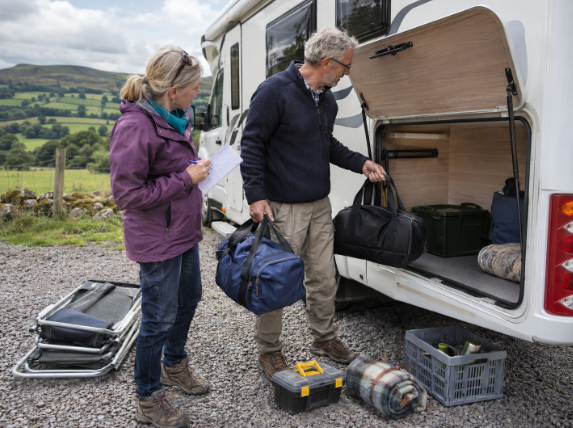
Then consider the things that make a holiday comfortable: food, bedding, chairs, tables, cooking equipment, clothing, bikes and children’s gear. It is easy for a collection of relatively small items to become a substantial load. A simple packing list with approximate weights will give a more realistic picture than guessing.
A large rear garage does not mean unlimited capacity
Garages and rear storage compartments are useful, especially for longer trips, but they have their own practical limits. The motorhome must remain within its overall permitted weight and its separate front and rear axle limits. A vehicle can be under its total weight limit and still have too much weight over one axle.
This matters when carrying electric bikes, a bike rack or heavy equipment towards the back of the vehicle. Weight positioned far behind the rear axle can have a pronounced effect on the load carried by that axle and on the vehicle’s handling. Check both the permitted garage load and any limits for racks or other fittings.
Pack heavy items securely, as low and as sensibly positioned as the manufacturer’s guidance allows. Keep frequently used items accessible, but do not let convenient cupboards determine where every heavy object goes. Weight distribution is part of safe loading, not merely an exercise in fitting everything inside.
Check the loaded weight, not just the brochure
Before choosing a model, work out what a normal departure day would look like. How many people will be aboard? Will you carry bikes? Do you normally travel with fresh water? Are there any extras you would want fitted immediately? Put rough weights beside each item and compare the total with the payload available for that specific vehicle.
Driving licence entitlement matters as well. Many drivers with a standard category B licence can drive a petrol or diesel motorhome up to 3,500kg MAM, while a heavier motorhome generally requires the appropriate additional entitlement, such as category C1. Check the categories shown on your own licence before considering a vehicle above that threshold.
For a more accurate picture, a motorhome packed as it would be for a trip can be weighed at a public weighbridge. Ask about obtaining both the total weight and the individual axle weights, then compare them with the vehicle’s plated limits. This is particularly useful after adding accessories or changing the way you pack.
Payload may not be the most exciting part of choosing a motorhome, but it has a direct effect on how easily you can use it. A practical layout is one that leaves enough carrying capacity for the people and equipment you actually intend to take.