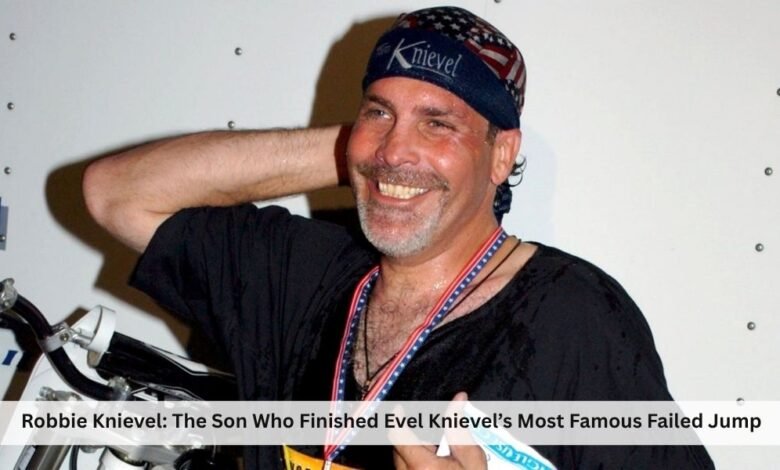
Robbie Knievel had a name that came with noise, danger, and history. He was not just a rider. He was the son of Evel Knievel, one of the most famous daredevils in America. That made Robbie’s life very different from the start. Many people looked at him and saw his father first. They expected big jumps, big shows, and big risk. But Robbie Knievel had his own story.
One of the strongest parts of that story was his 1989 jump over the Caesars Palace fountains in Las Vegas. That jump mattered because Evel Knievel had tried the same place in 1967 and crashed badly. Robbie later completed the jump his father could not finish. The Los Angeles Times reported that Evel nearly died after the 1967 crash, while Robbie completed the jump in 1989 on a specially designed Honda.
The Weight of the Knievel Name
To understand Robbie Knievel, it helps to understand the weight of his last name. The Knievel name was tied to ramps, crowds, cameras, and fear. Evel Knievel did not become famous by playing it safe. He became famous because people watched him try things that looked impossible. Some people watched because they wanted to see him win.
Others watched because they feared he might crash. That made the Knievel name exciting, but also heavy. For Robbie, the name was both a gift and a burden. It opened doors for him, but it also placed a big shadow over him. He had to prove that he was more than a famous man’s son. He had to show that he could ride, plan, jump, and face fear in his own way.
A Father’s Famous Failed Jump
The Caesars Palace jump became one of Evel Knievel’s most famous moments. It was not famous because it ended well. It was famous because it ended in a terrible crash. Evel tried to jump the fountains at Caesars Palace in Las Vegas in 1967. The official Evel Knievel biography says the crash caused a crushed pelvis and femur, fractures to his hip, wrist, and both ankles, and a concussion that left him in a coma for 29 days.
That crash became part of American stunt history. It showed the danger behind the show. It also helped make Evel a bigger name. People remembered the crash because it looked unreal. But for the Knievel family, it was not only a show. It was pain, fear, and a memory that stayed for years.
Robbie’s Jump Was More Than a Stunt
When Robbie Knievel jumped the Caesars Palace fountains in 1989, it was not just another stunt. It was a son riding into a place where his father had almost lost everything. That gave the jump deep meaning. Robbie was not only trying to clear a gap. He was trying to close a family story. Many riders can jump ramps.
Few riders carry a story that big on their back. Robbie had to deal with the crowd, the cameras, and the old memory of his father’s crash. Every person there knew what had happened before. That made the jump feel like a second chapter. It was a public act, but it also felt personal. Robbie was stepping into the same danger and trying to give the story a better ending.
Why the 1989 Caesars Palace Jump Stood Out
The 1989 Caesars Palace jump stood out because it linked two generations. Evel’s crash in 1967 had become a symbol of risk. Robbie’s completed jump in 1989 became a symbol of family legacy. The Los Angeles Times archive said Robbie was scheduled to jump over the same Caesars Palace fountain that had put his father into a coma in 1967.
That detail is important. Robbie was not choosing a random place. He was choosing the place that helped make the Knievel name famous. He was also choosing the place that nearly destroyed his father’s body. That mix of fame and pain made the jump powerful. It was not just about distance. It was about memory.
The Son Did What the Father Could Not Finish
There is a strong human reason this story still works for readers. Many families have unfinished stories. Some are about dreams. Some are about pain. Some are about trying again after failure. Robbie Knievel’s jump fits that kind of story. Evel tried the jump and crashed. Robbie came years later and completed it.
The Deseret News reported that Robbie became the first man to successfully jump the Caesars Palace fountains, vaulting about 160 feet in April 1989. That fact gives the story a clear shape. First, the father falls. Then, years later, the son rises. It sounds simple, but the feeling behind it is strong. Readers understand that kind of moment.
Not Just Copying Evel Knievel
Some people may think Robbie Knievel only copied his father. That is too simple. Yes, he followed the same kind of career. Yes, he used the famous Knievel name. Yes, he repeated some jumps connected to Evel’s history. But Robbie still had to ride the bike himself. He still had to face the ramp, the speed, and the landing.
A famous name cannot land a motorcycle. A famous father cannot control the bike in midair. When Robbie jumped, the risk was real. The pain would be his if something went wrong. That makes his work different from only living on family fame. He used his father’s legacy, but he also had to earn each safe landing with his own body.
The Public Loved Danger, But the Danger Was Real
Robbie Knievel’s career also shows something about the public. People love danger when they can watch it from a safe place. A crowd can cheer from seats. TV viewers can sit at home. But the rider is the one who faces the landing. That is the hard truth behind daredevil fame. It can look fun from far away.
It can look like bright lights, fast bikes, and loud cheers. But the rider knows what can happen. A small mistake can cause a broken bone or worse. CBS News reported that Robbie Knievel had a career with 350 jumps and 20 world records, based on his official biography. Those numbers sound exciting, but they also show how many times he accepted real risk.
A Different Kind of Family Tribute
Robbie’s Caesars Palace jump can be seen as a family tribute. But it was not a soft tribute with speeches and flowers. It was a tribute made with speed, steel, and danger. That kind of tribute matched the Knievel family story. Evel built his name through risk. Robbie honored that name by facing the same place where Evel had fallen.
This makes the article angle stronger than a basic life story. It is about how some families pass down more than money or memories. They pass down pressure. They pass down dreams. They pass down unfinished moments. Robbie took one of those moments and changed its ending. He could not erase his father’s crash, but he could add a new chapter after it.
The Pressure Before the Jump
Before the 1989 jump, Robbie had more than one problem to face. He had to ride well. He had to trust his bike. He had to trust the ramp. He also had to handle the story around him. Everyone knew Evel had crashed there. That made the pressure bigger. If Robbie failed, people would compare his crash to his father’s crash.
If he won, people would say he finished the family story. This kind of pressure can break a person. But Robbie used it as part of the moment. He did not run from the old crash. He rode toward it. That is why the jump still has meaning. It was brave because the danger was physical and emotional.
What Robbie Knievel’s Story Teaches Readers
Robbie Knievel’s story can teach readers more than stunt history. It shows that a person can inherit a hard story and still make something new from it. Robbie did not choose the famous crash that came before him. He did not choose the public memory tied to his father’s body. But he did choose how to respond.
He chose to ride. He chose to face the same place. He chose to take the risk in front of the world. This does not mean every person should take dangerous risks. It means that unfinished stories can be faced. Some people face them with words. Some face them with work. Robbie faced one with a motorcycle.
The Cost Behind the Cheers
It is easy to cheer when a stunt goes well. It is harder to think about the cost. Daredevil work can harm the body. It can also shape a person’s whole life around risk. Robbie Knievel’s career was full of big moments, but those moments came with danger. His story reminds readers that entertainment can have a human price.
The crowd may remember the jump. The rider may remember the fear, the pressure, and the pain. This is why a good article about Robbie should not only praise the show. It should also respect the risk. He was not a cartoon hero. He was a real person with a real body. Every jump had a cost, even when it ended well.
Why This Article Angle Feels Fresh
This angle is fresh because it does not only ask, “Who was Robbie Knievel?” It asks, “What did Robbie Knievel finish for his family?” That question gives the article heart. It moves the story away from plain dates and records. It turns the Caesars Palace jump into a family moment, a public test, and a symbol of legacy.
The keyword Robbie Knievel can fit naturally because the story stays focused on him. The article can include Evel Knievel, but Robbie remains the center. That is important. He should not be treated only as a side note in his father’s story. Robbie made his own mark when he completed the jump that had once ended in disaster for Evel.
Final Thoughts
Robbie Knievel’s 1989 Caesars Palace jump remains one of the best ways to understand his life. It was bold, public, and full of family meaning. Evel Knievel’s 1967 crash made the fountains a famous place in stunt history. Robbie returned to that same stage and gave the story a new ending. He did not remove the danger.
He did not remove the pain from the past. But he showed that a son could face the shadow of a famous father and still create his own moment. That is why Robbie Knievel’s story still matters. It is about motorcycles, but it is also about family, pressure, courage, and the hard work of finishing what someone before you could not.