There’s usually a binder. Grey, three inches thick, sitting on a shelf in the quality office, and everyone can point to it. Ask the last time anyone opened it and you get a shrug. Meanwhile the same defect that prompted the binder in the first place is still showing up on the line every few weeks.
That’s the wall most organizations hit somewhere between “we need better quality control” and actually fixing the thing. They have inspections. They have standards. They have the binder. What they don’t have is anything tying it together into a shape a normal person can follow on a Tuesday.
That shape has a name, and getting your head around it properly can save months of guessing. Before anyone worries about audits, certifications, or which software to buy, the fundamentals have to land first. Jumping to tools without the underlying logic almost never sticks.
What Is a Quality Management System?
A quality management system is a formal set of policies, processes, and procedures for planning, controlling, and steadily improving how an organization delivers consistent quality. It isn’t one document. It isn’t one department’s problem, either. It reaches from how raw materials get sourced all the way to how a customer complaint gets closed out.
Strip it down and the system exists to answer one stubborn question. How do we make the right thing happen the same way every time, no matter who’s doing the work that day? That consistency is the whole difference between an organization with a real quality culture and one quietly running on luck and a few heroic individuals.
Most people meet the acronym long before they meet the meaning. QMS turns up in meetings, job ads, and audit checklists, usually with no one stopping to explain what’s actually behind the three letters. That gap, between hearing the term and understanding what it’s for, is exactly where beginners get stuck.
Why It’s Worth Caring About Early
The easy assumption is that quality management is a manufacturing thing, or a problem only for heavily regulated industries. Not really. A software team, a hospital, an accounting firm, they all lean on the same underlying logic. The output just looks different.
And the reasons go well past keeping an auditor happy. Fewer defects and reworks pull costs down over time. Customers feel consistency, and consistency earns trust faster than any marketing line ever will. Staff stop burning hours firefighting the same recurring mess. And a certification like ISO 9001 can open doors to contracts that flatly require proof your processes are mature.
Beginners often picture the whole system as something built to satisfy auditors. It’s a narrow read. The real return shows up internally, long before any certification body ever walks through the door.
The Core Pieces
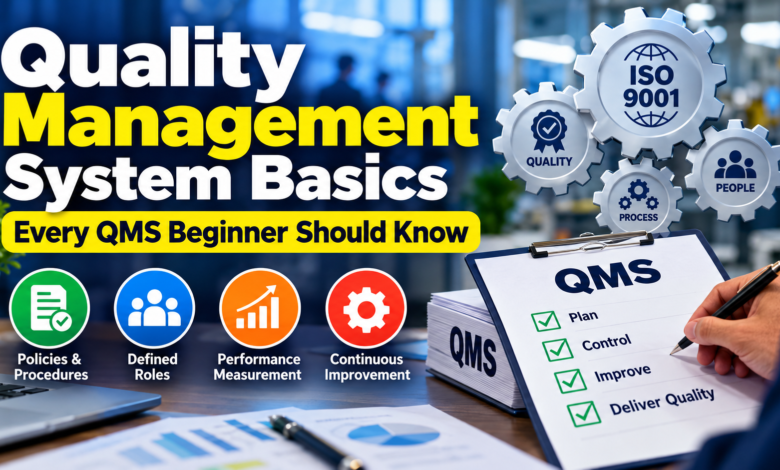
Frameworks differ, but most systems are built from the same handful of blocks: documented policies and procedures that spell out how work should be done, defined roles so accountability doesn’t stay fuzzy, a way to measure performance against actual quality objectives, a structured route for handling nonconformities and complaints, and improvement cycles that use real data to sharpen processes as you go.
The catch is that none of these do much on their own. Documentation with no measurement turns into shelfware. Measurement with no feedback loop just spits out reports nobody reads. The value lives in how the pieces connect and feed each other, which is what turns a pile of individual habits into something that behaves like a system.
Where QMS Thinking Shows Up Day to Day
A quality management system that only exists in an annual audit binder isn’t really doing its job. A working one shapes small daily decisions, from how a supervisor handles a bad batch to how a new hire learns the standard way to do something.
Take a simple case. A complaint comes in about a defective product. In a place with no real system, it gets logged, maybe apologized for, and then quietly forgotten. In a place running a mature quality management system software, that same complaint kicks off a root cause investigation, a corrective action, and a quick check on whether the same defect has shown up anywhere else. Over months, that gap compounds into far fewer repeat problems and steadier customer trust, even though in the moment the complaint arrives it feels like extra work.
Documentation earns its keep here too. When the system is well kept, a new employee isn’t left guessing how something’s done. The procedures already carry the organization’s accumulated lessons, instead of those lessons living only in the heads of three people who’ve been there twelve years.
Where Beginners Trip Up
The same mistakes recur when a first system goes in. Teams treat the documentation itself as the finish line, rather than a tool for consistency. They copy a generic template without ever bending it to fit how the work actually flows. They hand ownership to one department instead of threading responsibility across teams. They fixate on the certificate rather than the improvement underneath it. And they let procedures go stale after a process changes, so the document and the reality slowly drift apart.
Every one of those comes from the same habit: treating the system as paperwork instead of a living thing that’s supposed to change as the organization does. Fixing that mindset tends to matter more than any template or software you pick, and it’s usually the line between a system people use daily and one that gets dusted off the week before an audit.
Getting Started Without Overreaching
For a beginner, the pull is to charge straight at certification. A steadier path starts smaller.
Map your existing processes as they genuinely happen, not as some outdated manual describes them. Find where the inconsistencies and recurring problems already live, because those are where a formal system pays off fastest and most visibly. From there, write documentation that matches reality, put clear ownership on each process, and set up one simple way to see whether the quality objectives are being met.
Plenty of organizations eventually reach for digital tools to keep this from sprawling, since spreadsheets and shared drives get unmanageable fast once the documentation grows. A dedicated QMS platform can pull procedures into one place, track nonconformities, and fire off review reminders on its own, which starts to matter a lot the moment you scale past a handful of processes and manual tracking begins to crack.
It’s also worth getting familiar with the recognized standards early, even before you chase formal certification. The ISO 9001 overview from the International Organization for Standardization lays out the principles most modern systems are built on, and it’s useful context for a beginner trying to work out what an auditor will eventually be looking for.
Building Value, Not Just a Certificate
The organizations that get the most out of a Quality management system are rarely the ones chasing the certificate for its own sake. They’re the ones treating quality as an operating habit, reviewed and refined continuously rather than dragged out once a year before an audit.
That shift changes the questions people ask. Instead of “what do we need to show the auditor,” it becomes “what’s actually causing this, and how do we stop it coming back.” Asked consistently, that second question is what separates a system that exists on paper from one that genuinely improves how the place runs.
The Takeaway
Getting the basics of a quality management system is less about memorizing vocabulary and more about seeing why consistency matters at all. QMS isn’t a bureaucratic hurdle bolted on from outside. Handled well, it becomes the quiet infrastructure that keeps quality steady even as teams turn over, processes scale, and customers expect more.
If you’re just starting, day-one perfection isn’t the target. The target is building a habit of asking sharper questions about how work actually gets done, with a structure underneath that makes the answers easy to track, act on, and improve. Stick with it long enough and organizations tend to stop calling it a program at all. It just becomes how they work.