
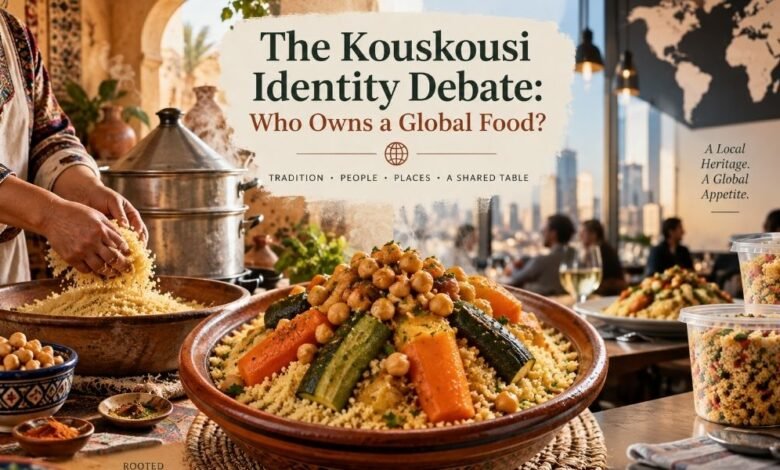
Kouskousi looks simple on the plate, but its story is not simple at all. It is small, soft, and easy to serve with stew, vegetables, lamb, chicken, fish, or chickpeas. Yet behind this food is a bigger question about culture, memory, and respect. Many people know it as couscous, while some use names like Kouskousi in regional or online food writing.
A food guide on Kouskousi describes it as a North African dish made from durum wheat semolina granules that are shaped and steamed, not boiled like rice. That small detail matters because Kouskousi is not only an ingredient. It is also a method, a habit, and a food tradition shaped by many hands over many years.
Why Ownership Feels Complicated
The question “Who owns Kouskousi?” sounds easy, but food does not work like a product label. A recipe can cross borders long before modern countries draw lines on maps. Families move. Traders move. Workers move. Restaurants move ideas from one city to another. Kouskousi is closely linked with North African food culture, especially the Maghreb region.
UNESCO says couscous traditions were jointly submitted by Algeria, Mauritania, Morocco, and Tunisia, and were inscribed in 2020 as intangible cultural heritage. That does not mean one country owns every bowl. It means the knowledge around the food has deep cultural value. It also means credit should not disappear when the dish becomes popular in supermarkets and restaurants far away.
The UNESCO Moment
The UNESCO listing is important because it did not treat couscous as only a menu item. It treated it as knowledge, skill, and shared practice. UNESCO said the inscription recognized the value of couscous and the practices around it, and also showed cultural cooperation between Algeria, Mauritania, Morocco, and Tunisia.
This matters for Kouskousi because the debate is not only about who first cooked it. It is also about who kept the methods alive. Rolling, steaming, seasoning, serving, and sharing all carry meaning. When Kouskousi appears on a restaurant menu without any cultural context, part of that meaning can vanish. The UNESCO record reminds readers that a dish can be ordinary dinner and cultural heritage at the same time.
More Than a Trend
Global food media often turns traditional dishes into trends. A food becomes popular because it is quick, pretty, cheap, or easy to photograph. Kouskousi can fall into that pattern. It is light, flexible, and simple to pair with many foods, so it is easy for brands to sell it as a modern pantry item. But the problem starts when marketing makes Kouskousi look rootless.
If a package only says “Mediterranean grain bowl” or “healthy couscous side,” it may hide the North African story behind the food. That does not mean every brand is doing harm. It means brands should be careful. Kouskousi can travel around the world, but its cultural credit should travel with it.
The Meaning of Authentic
The word “authentic” is useful, but it can also be lazy. A restaurant may call a Kouskousi dish authentic because it uses spices, a clay pot, or a family-style plate. But true respect needs more than decoration. Authenticity should explain the method, the region, and the people behind the dish.
UNESCO notes that couscous is linked with family reunions, weddings, parties, daily meals, and moments of joy and sorrow. It also says the dish is tied to memories, traditions, know-how, and gestures passed from one generation to another. That is hard to capture with one menu word. A better menu can say where the recipe style comes from and why the dish matters.
When Credit Gets Removed
The biggest concern is not that people outside North Africa enjoy Kouskousi. Shared food can build respect. The concern begins when credit is removed. A chef may change the name. A brand may soften the origin. A magazine may write about the health benefits but ignore the communities that created the food.
Over time, the dish may look like a general global product instead of a North African food tradition. That is how culture can become a commodity. One academic conference paper on couscous argued that the global trade in couscous is also tied to questions of colonial history, women’s labor, industrial production, and commodification. This shows why the Kouskousi debate is deeper than taste. It is also about power.
Women and Hidden Labor
Kouskousi has often been made through careful hand work. Traditional couscous needs rolling, drying, steaming, and separating. These steps can take time. In many food cultures, women’s kitchen labor carries family memory, but it is not always treated as expert work. UNESCO’s article says women play a key role in preparation, consumption, and the conservation of symbolic values linked with couscous.
It also mentions farmers, millers, traders, artisans, and hotel owners as part of the wider social fabric around the dish. This wider view is important. Kouskousi is not created only at the final restaurant stage. It is created by growers, cooks, tool makers, and families who protect the method before the dish reaches the public plate.
The Industry Problem
Food businesses need simple labels. Supermarkets need shelf names. Restaurants need short menus. Online recipes need keywords. That pressure can flatten the story of Kouskousi. A long cultural history becomes a short product description. The food becomes “easy side dish,” “healthy carb,” or “Mediterranean bowl base.” Some of these phrases are not wrong, but they are incomplete.
Kouskousi can be quick and useful, especially when pre-steamed products are used. The Academy of Nutrition and Dietetics notes that couscous sold in the United States is often pre-steamed and dried, so it can be reconstituted quickly in boiling water. Convenience is not the enemy. The real issue is convenience without memory, origin, or respect.
Naming Can Change the Story
Names carry history. Couscous, kouskous, seksu, keskes, and Kouskousi may point readers toward different languages, regions, and communities. A name can keep a food close to its roots, or it can make the food easier to sell in another market. The Trendify Magazine guide says “Kouskousi” is often used as a regional name for traditional couscous in parts of North Africa, while the basic dish remains similar.
That means writers should use names with care. They should not pretend every spelling has the same local meaning everywhere. They should also avoid turning Kouskousi into a mystery word with no background. A responsible article can explain the name while still respecting local variation.
Borrowing or Respect
Food borrowing is not always bad. Many loved dishes became famous because people cooked them outside their first homes. A student may cook Kouskousi in London because it is fast. A family in Toronto may serve it with local vegetables. A chef in New York may create a careful North African-inspired menu and name the region clearly.
These examples can be respectful when they give credit and do not claim ownership they have not earned. The line is crossed when someone takes the food, erases the source, and profits from the image of “exotic” culture. Kouskousi does not need to stay locked in one place. But it should not be stripped of the people and histories that gave it meaning.
How Writers Should Handle It
A good blog post about Kouskousi should not only ask what it is. It should ask how to write about it fairly. Start with the food itself: small durum wheat semolina granules, often steamed and served with stew or vegetables. Then explain the cultural link to North Africa and the Maghreb. Mention the UNESCO inscription, but do not use it as a trophy.
Use it as proof that the knowledge around couscous has shared cultural value. Avoid saying one country owns the whole dish unless a strong source supports that claim. Also avoid fake health promises. Kouskousi can be part of a balanced meal, but its value depends on portion size, added ingredients, and the full diet.
What Respect Looks Like
Respect can be simple. A restaurant can add one sentence about the regional style of its Kouskousi. A food brand can name North African roots on the package. A recipe writer can explain the difference between instant preparation and traditional steaming. A blogger can link to UNESCO or reliable food references instead of copying weak claims from random sites.
A home cook can learn why a couscoussier matters, even if they use a faster method on busy nights. These small acts do not stop the dish from changing. They help change happen with honesty. Kouskousi can still be modern, simple, and global. It just does not need to lose its old story to become useful today.
Final Thoughts
Kouskousi shows how food can become global without becoming empty. It can sit in a supermarket box, a home kitchen, a restaurant bowl, or a family feast. But every version carries a choice. Writers, chefs, and brands can treat Kouskousi as only a quick carb, or they can tell readers where the dish comes from and why it matters.
The fair answer to “Who owns Kouskousi?” is not one simple name. It belongs to the cultures, families, workers, and communities that shaped it, protected it, and shared it. Global popularity becomes cultural borrowing when credit disappears. It becomes respect when the story is served with the food.