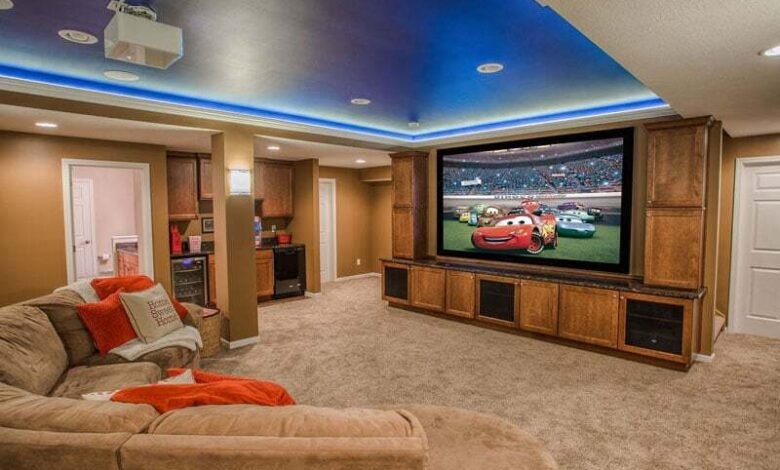
A dedicated media room represents far more than an assembly of consumer electronics housed within a spare bedroom. Modern high-output audiovisual technology exerts immense physical demand on residential architecture, requiring strict control over acoustic reflections, dedicated electrical circuits, and precise structural framing. When high-end media gear is installed into standard residential framing without prior engineering, the room itself becomes the single greatest bottleneck to performance.
For homeowners investing in premium entertainment environments, building or renovating a space specifically tuned for sound and image requires an architectural approach. Understanding how structural layout, power isolation, and room geometry interact ensures that performance matches the capability of top-tier hardware.
The Physics of Indoor Acoustics and Room Geometry
Every enclosed space acts as an acoustic filter, selectively reinforcing or canceling specific sound frequencies based entirely on its physical dimensions. Standard residential rooms—often built with parallel drywall surfaces, standard eight-foot ceilings, and hardwood or tile flooring—create severe acoustic anomalies that no digital equalizer can correct.
When sound waves bounce between parallel walls, they form stationary wave patterns known as room modes. These standing waves cause dramatic dips and spikes in low-frequency response, resulting in boomy, muddy bass in certain seating positions and a complete absence of low-end impact in others.
Key architectural elements required to mitigate room mode issues include:
- Non-Parallel Wall Layouts: Angling walls slightly or integrating splayed framing prevents flutter echo and smooths out standing wave distribution across the room.
- Dimensional Ratios: Utilizing golden acoustic ratios during initial framing balances room dimensions (height, width, and length) to distribute low-frequency modes evenly across the audio spectrum.
- Integrated Acoustic Framing: Constructing deep wall cavities allows for flush-mounted bass traps and acoustic absorption panels behind acoustically transparent fabric, maintaining a clean interior design while eliminating flutter echo.
According to structural design frameworks published in the National Institute of Standards and Technology (NIST) Campus Construction Standards, integrating acoustic control directly into physical wall structures dramatically improves environmental sound isolation compared to surface-mounted retrofits.
Power Infrastructure and Signal Isolation
High-performance audio amplifiers and processing equipment demand massive, instantaneous bursts of electrical current. Plugging sensitive home theater hardware into standard residential branch circuits shared with household appliances, HVAC units, or LED dimmers introduces severe electrical noise into the signal path.
Electrical noise manifests as audible hums through speakers, visible grain or banding on display panels, and a compressed dynamic range. Building a purpose-built media space requires isolated power distribution designed specifically for high-amperage, low-noise applications.
Proper electrical planning for high-end media installations includes:
- Dedicated Subpanels: Installing a dedicated electrical subpanel exclusively for the media room prevents voltage sags caused by major household appliances turning on elsewhere in the home.
- Isolated Grounding: Utilizing isolated ground receptacles ensures that stray electrical currents bypass sensitive processing gear, lowering the noise floor and preserving fine detail in audio signals.
- Heavy-Gauge Supply Lines: Running dedicated 20-amp copper lines directly from the main panel to high-current power amplifiers guarantees clean, uninterrupted current delivery during dynamic audio passages.
Operational guidelines detailed in the U.S. Department of Energy (DOE) Federal Energy Management Program Wiring Guidelines highlight how dedicated circuit isolation reduces total harmonic distortion and prevents power degradation in specialized electrical installations.
Acoustic Isolation and Structural Decoupling
True high-performance media spaces require aggressive sound isolation—both to keep external noise out and to prevent high-volume media from disrupting the rest of the household. Achieving true sound isolation requires decoupling the room’s inner surfaces from the main building structure to eliminate vibration transfer.
Standard drywall mounted directly to wooden studs acts as a diaphragm, transmitting low-frequency energy directly through the floor joists and ceiling framing. High-performance media rooms rely on a “room-within-a-room” construction methodology.
| Isolation Method | Standard Construction | Purpose-Built Media Framing |
| Stud Alignment | Shared single-stud framing | Staggered stud or double-stud walls |
| Drywall Mounting | Direct screw attachment | Resilient sound isolation clips (RSIC) & hat channels |
| Mass & Damping | Single sheet 1/2-inch drywall | Constrained-layer damped double 5/8-inch drywall |
| Doorway Sealing | Standard hollow-core door | Solid-core or acoustic door with drop seals |
By floating the drywall framework on resilient isolation clips and applying viscoelastic damping compounds between layers of mass-loaded drywall, low-frequency kinetic energy is converted into low-grade heat rather than transmitting as vibration through the home’s structure.
Seamless Architecture and Clean Component Integration
Modern interior design demands that high-performance media spaces maintain a refined aesthetic, free from exposed wiring, bulky component racks, or intrusive speaker boxes. Achieving this requires early coordination between home builders, interior designers, and audio-system architects.
Integrating high-performance audio systems requires precision planning during the rough-in stage of construction. Installing custom-engineered in-wall backboxes, concealed wiring conduits, and climate-controlled equipment closets preserves room aesthetics without sacrificing thermal management or acoustic output.
Property owners designing custom entertainment environments in North Texas frequently consult experienced integrators specializing in Hi-Fi audio systems in Dallas to coordinate structural wiring layouts and speaker placements alongside their primary home builder before drywall installation begins.
Thermal Management and Equipment Longevity
High-end power amplifiers, video processors, and media servers generate massive amounts of thermal energy. Enclosing high-output hardware inside sealed cabinets or unventilated closets drastically shortens component lifespans and causes systemic thermal throttling or equipment failure.
Designing a purpose-built media space requires an independent, quiet HVAC strategy capable of exhausting heat continuously without introducing ambient fan noise into the listening environment.
Critical thermal management strategies include:
- Thermostatically Controlled Active Exhaust: Installing whisper-quiet inline duct fans that pull hot air from the top of the rack and vent it into a return air plenum or exterior space.
- Low-Velocity Supply Ducts: Utilizing oversized, insulated ductwork with oversized grilles reduces air velocity, preventing HVAC air turbulence noise from elevating the noise floor in the room.
- Remote Equipment Placement: Locating component racks in a nearby dedicated utility space reduces ambient room heat and completely removes component fan noise from the listening zone.
Research from the U.S. Bureau of Labor Statistics Occupational Outlook Handbook for Network and Systems Architects underscores that thermal management and structured cabling are fundamental requirements for maintaining high-uptime infrastructure across complex enterprise and residential installations alike.
By viewing a high-performance media space as an integrated engineering challenge—combining structural physics, electrical isolation, and clean architectural design—homeowners create purpose-built environments that deliver uncompromising media experiences while enhancing the long-term value of their property.