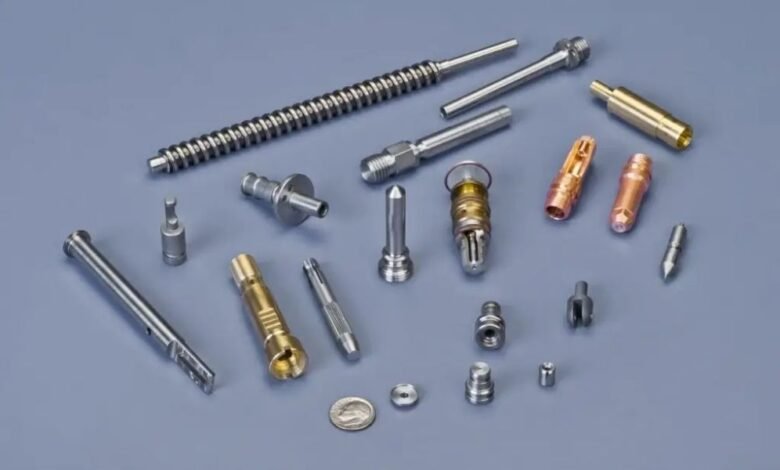
Precision components with long and slender shapes are difficult to produce in the usual turning processes. Very small diameters and long lengths can rapidly impact accuracy and surface quality due to vibration, deflection, and irregular cutting. The Swiss-type CNC technology overcomes these challenges by providing continuous material support in the vicinity of the cutting area. Manufacturers can create narrow parts, such as shafts, pins, screws, connectors, and more, with more stability and repeatability when controlling movement.
-
Why Long, Slender Parts Create Machining Challenges
The more a part extends beyond its diameter, the more important it is to have a stable machining process. A narrow workpiece is likely to bend or vibrate under cutting forces, particularly if it is not supported and an unsupported portion extends a long way from the holding mechanism. Even slight movement can affect dimensions, concentricity, quality of thread, and surface finish.
When the parts are very long and small diameter, they may be bent during turning and become difficult to turn by conventional turning. Other support systems may be helpful but can also make production more complicated and may limit access to the tools. In Swiss-type machining, the workpiece is supported directly in the vicinity of the cutting area, and this method of solving the problem is different.
Such close support means that the material has a shorter unsupported length when it is being cut. Therefore, cutting forces have less time to act to produce deflection. Thus, the machine can keep the cutting tool and workpiece in a more stable relationship during complex operations.
-
The Sliding Headstock and Guide Bushing Advantage
The main characteristic of the Swiss-type machining system is its sliding headstock. The bar stock is fed into the machine through a guide bushing to the cutting tools instead of the entire workpiece being held in a traditional fixed position. The guide bushing is used to support the material near the location where it is being machined.
This is an excellent solution for narrow components. In cutting, only a small part of the material is exposed, reducing the chances of vibration. As features are formed, the workpiece passes through the guide system to enable the machine to provide support during production.
This is especially useful for parts with close tolerances, long lengths, and high geometric tolerances. Controlled material support also provides consistency if there are multiple machining operations along the same part.
Swiss machining services are a convenient way for manufacturers to make technically complex parts, while also enjoying stable cutting and high-precision manufacture. Especially effective in situations where conventional setups have problems controlling slender stock without inducing too much vibration.
-
Maintaining Accuracy Throughout Complex Cutting Operations
Stable cutting is not just about the final look of a finished component. It also helps to maintain dimensional consistency of key features. A vibrating workpiece can cause inconsistent results from a precisely programmed machine since the material is moving off of the intended cutting position.
With Swiss machines, this worry is eliminated because the stock is supported during the process and advanced CNC controls coordinate multiple axes. Often, turning, drilling, milling, threading, grooving, and cross-hole machining can be performed in one integrated production setup.
This is useful for a part that has multiple precision features on the side of a narrow body. Manufacturers can perform many operations without having to move the part from one machine to another. With reduced handling, alignment errors between machining stages are also minimized.
This is especially relevant for 3ERP’s precision parts manufacturing, where the dimensional accuracy and controlled geometry are key factors in meeting application requirements. The company has Swiss-type capabilities with more general rapid manufacturing skills to cater for projects that involve prototypes, low-volume production, and larger manufacturing needs.
-
Key Advantages of Stable Swiss-Type Cutting
The advantages of Swiss machining become most apparent when part geometry demands continuous support and precise tool control.
Why stable Swiss-type cutting matters:
- Reduced workpiece deflection: Guide bushing support helps prevent narrow material from bending during machining.
- Lower vibration levels: A shorter unsupported section improves cutting stability and dimensional consistency.
- Improved surface quality: Controlled cutting conditions can help produce smoother finishes on precision components.
- Tighter tolerances: Stable material positioning supports demanding dimensional requirements, including tolerances around ±0.001 inch or better when appropriate.
- Complex feature integration: Multi-axis machining can combine turning, drilling, milling, and threading efficiently.
- Better production repeatability: Consistent support helps maintain similar results across multiple manufactured parts.
These advantages make the process particularly useful for parts that must combine small dimensions with intricate functional features.
-
Material Choices for Long and Precision Components
The selection of materials has a significant impact on the behaviour of the materials during machining and the performance and quality of the resulting component. In harsh environments, for instance, stainless steel provides strength and corrosion resistance. Precision production can also be achieved with grades like 303, which offer good machinability.
Aluminium alloys are interesting materials for a combination of low weight, good machinability, and structural characteristics. Brass offers good cutting properties and often can be used for precise parts that need smooth machining. Connectors and contacts are still important uses of copper and its alloys for electrical and thermal applications.
Titanium, alloy steel, carbon steel, or nickel-based materials are required for more demanding applications. Machining engineering plastics, such as PEEK, acetal, nylon, and PTFE, can also achieve special mechanical, chemical, or thermal properties of lightweight components.
The choice of material depends on cutting characteristics, part geometry, cutting conditions, and tolerances. Stable machining technology can improve processing control, while the characteristics of materials are still the main factors in obtaining reliable processing results.
-
Supporting Industries That Depend on Precision
Precision parts that are long and slender are everywhere in industry where reliability of components is of major concern. Medical manufacturing involves the production of narrow screws, implants, surgical parts, and instrument components, which could have complex features and precise dimensions.
Small shafts, connectors, fasteners, hydraulic components, and fuel-system parts are used in aerospace applications. Precision parts can be needed for automotive systems such as fuel injection and transmission, valve assemblies, and engine assemblies.
Miniature contacts, pins, connectors and special housings are also critical for electronics and advanced engineering applications. Swiss-type technology enables the production of complex geometries in small dimensions, which is ideal for products where space is still a constraint.
3ERP’s ISO 9001:2015-certified quality management approach is used throughout the manufacturing process, helping to ensure the processes are consistent for precision projects using a variety of metals and engineering plastics.
-
Efficiency Through Fewer Setups and Integrated Operations
The number of times a component is moved around during production is crucial to production efficiency. Each machine transfer adds to the handling and possible alignment requirements. These interruptions can be minimised by combining multiple operations in a coordinated setup on Swiss-type CNC machines.
External turning, internal drilling, threading, slots, grooves and cross features may be required on a narrow component. It is possible to run some of these operations on the same machine environment to streamline workflow and enhance feature consistency.
This integration can be particularly beneficial during manufacturing of large volumes of small precision parts. With optimized tooling and programming, the machine can repeatedly process bar stock with stable support near the cutting location.
But not every part is necessarily a candidate for Swiss machining. Conventional CNC turning or milling might be more appropriate for large parts, simple geometries, and designs that must change often. The choice of process should always be consistent with the dimensions, geometry, material, and quantity of the component.
Conclusion
Long slender parts require more control as vibration and deflection can easily affect the quality of the parts being machined. The Swiss-type CNC technology overcomes these challenges by having a sliding headstock and guide bushing system that holds material near the cutting zone. This steady motion not only enhances accuracy but also allows for intricate details on small parts.
Stable cutting has a direct impact on dimensional stability and production efficiency for manufacturers producing shafts, pins, screws, connectors, bushings, and other complex precision parts. 3ERP can help develop challenging parts that require thin wall thickness to meet tight tolerances by adapting Swiss-style technology with appropriate materials and meticulous machining processes.