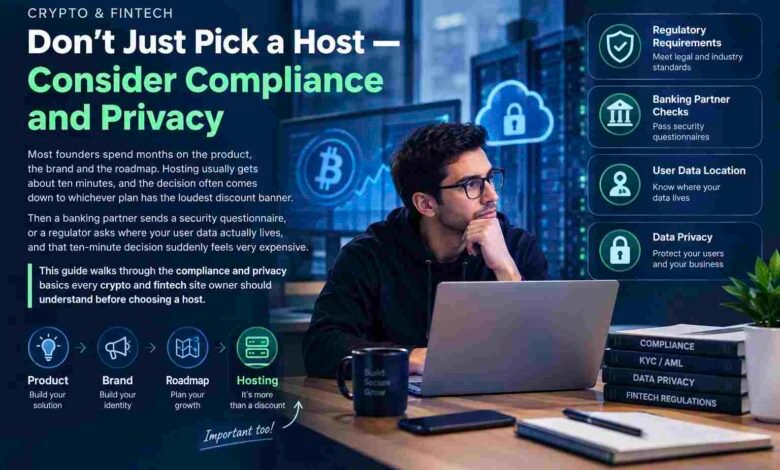
Most founders spend months on the product, the brand and the roadmap. Hosting usually gets about ten minutes, and the decision often comes down to whichever plan has the loudest discount banner.
Then a banking partner sends a security questionnaire, or a regulator asks where your user data actually lives, and that ten-minute decision suddenly feels very expensive.
This guide walks through the compliance and privacy basics every crypto and fintech site owner should understand before choosing a host.
Why Hosting Matters More for Financial Platforms?
A blog can survive a few hours of downtime. A crypto exchange, wallet dashboard or payment app usually cannot.
These platforms handle identity documents, transaction records and sometimes real money. Your hosting environment becomes part of your risk profile, which means regulators, auditors and partners may ask about it.
Three things set financial websites apart from ordinary ones:
- They store sensitive personal and financial data
- They are attractive targets for attackers
- They operate under rules that vary by country and by product type
Good hosting will not make you compliant on its own. A poor setup, however, can make compliance far harder than it needs to be.
Compliance Basics Every Crypto and Fintech Site Owner Should Know
Rules differ between regions, and they change often. The areas below come up in almost every market, so they are a sensible starting point for your conversations with a legal advisor.
Know Your Customer and Anti-Money Laundering Rules
Many jurisdictions require platforms that handle customer funds to verify identities and monitor suspicious activity. This means collecting passports, selfies, proof of address and transaction histories.
All of that data needs a secure home. Your server should support strong access controls, encrypted storage and reliable backups, because a KYC database leak is one of the most damaging incidents a fintech brand can face.
Data Protection Laws Such as GDPR
If you serve users in the European Union, the General Data Protection Regulation applies to you, wherever your company is registered. It covers how you collect, store, process and delete personal data.
Hosting location matters here. A data center inside the EU makes it easier to explain where data lives and which laws protect it. Other regions have their own privacy laws, so check the rules in each market you serve.
Payment Security Standards
If your platform accepts card payments, you will likely encounter PCI DSS, the security standard for cardholder data. Many businesses reduce their burden by using a payment processor that handles card details directly, so sensitive numbers never touch their own servers.
Even then, the site that hosts your checkout page still needs a hardened, patched and monitored environment.
Licensing and Local Regulations
Crypto and fintech licensing varies widely. Some countries have clear frameworks for exchanges and custodians, while others are still drafting them. Before you launch, confirm which licenses or registrations your product needs in your target markets.
This is a business and legal task, not a hosting task. Your host provides infrastructure. You remain responsible for operating lawfully.
Privacy Basics for Financial Platforms
Privacy is not only about satisfying regulators. Users in this space tend to be careful, and a visible privacy failure can end trust overnight.
Collect Less Data
The safest data is the data you never stored. Ask whether each field in your sign-up flow is truly required, and set retention limits so old records are deleted when you no longer need them.
Less stored data means a smaller breach impact and simpler compliance work.
Encrypt Everything That Matters
Encryption has two jobs, and a financial platform needs both.
Encryption in Transit
Every page and API call should run over HTTPS with a modern TLS configuration. Redirect all HTTP traffic, enable HSTS and renew certificates automatically so they never lapse.
Encryption at Rest
Databases, backups and uploaded documents should be encrypted on disk. If a drive is ever lost or copied, the data stays unreadable without the keys. Keep those keys separate from the server that uses them.
Control Who Can See What
Not every employee needs access to customer records. Apply least-privilege access, require two-factor authentication on every admin account, and keep audit logs of who accessed what and when. Review those logs regularly instead of only after an incident.
Choosing the Right Hosting Type
Shared hosting can work for a simple informational site, such as a project landing page, a whitepaper or a blog. It is rarely suitable for a platform that processes accounts or transactions.
For application-level work, these options are more common:
- VPS hosting: Dedicated resources and root access, which gives you control over firewalls, software versions and security tools
- Dedicated servers: Full hardware isolation, useful for exchanges, high-volume APIs and anything with heavy database loads
- Separate environments: A public marketing site on one plan and your sensitive application on another, so a problem in one does not spill into the other
Splitting the public site from the core application is a simple habit that many teams skip, and it is worth adopting.
Jurisdiction and Data Center Location: What to Check
Where your server sits decides which laws apply to the physical hardware and which authorities can make requests to your provider.
Ask your host these questions:
- In which country is the data center, and who operates it?
- What is the provider’s policy for legal requests and abuse complaints?
- Can I choose a location close to my main user base?
- What infrastructure standard does the facility meet?
A Tier III facility, for example, is built with redundant components so maintenance can happen without taking systems offline. That matters when your users expect to move money at any hour.
Also remember that a stable, privacy-respecting jurisdiction is not a loophole. Hosting abroad does not remove your duty to follow the rules of the markets you serve.
Security Features That Should Be Non-Negotiable
Before you sign up with any provider, confirm that the following are available:
- DDoS protection and network-level filtering
- Regular, tested backups stored away from the main server
- A firewall you can configure, plus easy access to security updates
- Root or administrator access for custom hardening
- Responsive support that can act quickly during an incident
- A clear uptime commitment
Then add your own layers: web application firewall rules, intrusion monitoring, malware scans and a written incident response plan. A plan you have never rehearsed is only a document.
Common Hosting Mistakes Crypto and Fintech Teams Make
A few errors appear again and again:
- Choosing the cheapest plan and never revisiting it as traffic grows
- Running the website, database and admin tools on one overexposed server
- Skipping backup restore tests until the day a restore is needed
- Ignoring provider policies on legal requests and abuse handling
- Assuming a host’s security covers application-level bugs
Most of these are cheap to fix early and costly to fix after launch.
Why QloudHost Is a Strong Hosting Partner for Crypto and Fintech Projects
Once you know what to look for, the next question is where to put it into practice. QloudHost is a web hosting provider built around privacy-focused infrastructure, offering DMCA Ignored Hosting and Offshore Web Hosting for businesses that want stronger control over where and how their sites are hosted.
Here is a quick overview of what the platform offers:
- Tier III data center in Amsterdam, Netherlands: Redundant infrastructure in a well-established European hosting hub, which also helps when you need to explain data location to partners or users
- DMCA Secure and Offshore hosting: A privacy-conscious approach to takedown handling and jurisdiction, suited to publishers, SaaS projects and web platforms that value independence
- Range of plans: Shared and WordPress hosting for informational sites, VPS plans from $17.99 per month on a 2-year term, and dedicated servers from $167.99 per month for heavier workloads
- Control panel choice: DirectAdmin by default, with cPanel available on request for teams that prefer it
- Room to scale: Start small, then move to VPS or dedicated hardware as your platform and traffic grow
One honest note: QloudHost provides infrastructure, and your project is still responsible for meeting the licensing, KYC and data protection rules in your own markets. For teams that handle that side properly, a stable, privacy-aware host is a solid foundation. You can explore the plans and talk to the team at QloudHost.
Frequently Asked Questions
Does my hosting provider make my crypto site compliant?
No. A host supplies secure infrastructure, but compliance depends on how you operate: licensing, KYC, data handling and reporting. Treat hosting as one supporting piece, not the whole answer.
Is shared hosting safe enough for a fintech website?
It can suit a simple informational page, but not a platform that stores customer accounts or processes transactions. VPS or dedicated hosting gives you the isolation and control those workloads need.
Why does data center location matter for a financial platform?
Location determines which laws apply to the hardware and affects latency for your users. It also shapes how you answer questions from auditors, partners and privacy regulators.
What security features should I look for in a host?
Look for DDoS protection, tested backups, firewall control, root access, timely support and a clear uptime commitment. Pair these with your own measures, such as encryption, two-factor authentication and monitoring.
Can I move my site to a new host without downtime?
Usually yes, with planning. Build the new environment first, copy data and test it, lower your DNS TTL, then switch records during a quiet period and keep the old server briefly as a fallback.
Conclusion
Crypto and fintech websites carry more responsibility than most, because they hold both money-related activity and personal data. Compliance, privacy and hosting are linked, and weak choices in one tend to show up in the others.
Start by understanding the rules in your target markets, minimize and encrypt the data you hold, and choose infrastructure with proper redundancy, clear policies and room to grow.
A little care at the hosting stage saves a lot of stress when the first audit, partner review or traffic spike arrives.