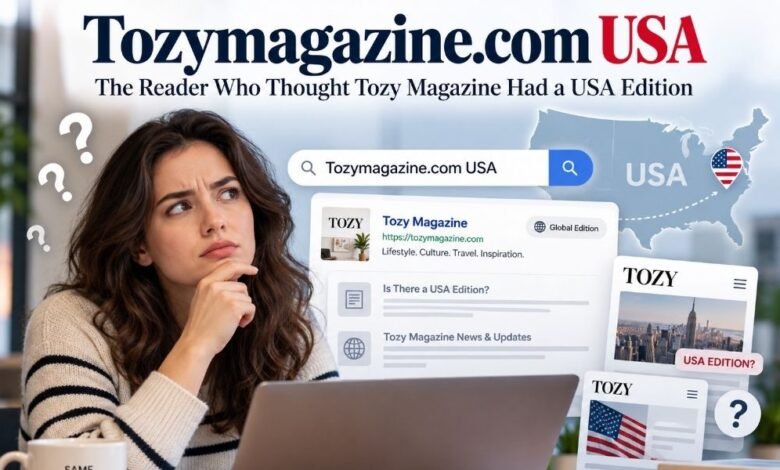
A reader in the United States opens Google and types tozymagazine.com usa. The search feels simple. The reader wants to know one thing. Is there a special U.S. version of Tozy Magazine? Maybe the site has an American page. Maybe it has U.S. writers. Maybe it has news or guides made only for people in America. But after looking closer, the answer is not that simple.
The phrase can confuse readers because it sounds official, but it may only show what people are searching for. The source page says “tozymagazine.com USA” does not appear to be a clearly separate U.S. edition. It is better understood as a search phrase from a U.S. point of view.
Why the Search Starts With Confusion
Many people add a country name after a website name. They may write “USA,” “UK,” “Canada,” or “Australia” after a domain. They do this because they want local details. They may want local prices, local laws, local shops, or local services. This habit is normal.
But it can also create a problem. A country word in a search box does not always mean the website has a real country edition. A person may search tozymagazine.com usa and think the phrase proves something. It does not. It may only mean that the reader is asking if the site matters to U.S. users.
What Tozy Magazine Seems to Be
Tozy Magazine describes itself as a place built around words, feelings, wishes, quotes, and messages. Its official About Us page says its mission is to give readers quotes, wishes, and messages for special moments. It mentions birthdays, anniversaries, weddings, and acts of kindness. It also says words can help people show love, thanks, and care.
This helps explain why many people may first know the site for message-style content. A person may visit it when they need a birthday wish, wedding line, thank-you note, or anniversary message. That kind of content is personal. It is not hard news. It is not deep research. It is content that helps people say something warm.
How the Website Became Broader
The confusing part is that Tozy Magazine is not only about wishes and quotes now. The page you shared says the website has expanded into more topics. It lists lifestyle, health, business, technology, home improvement, education, and other information topics. This is where readers may get mixed up.
One reader may come for a birthday message. Another reader may find a business article. Another may see a technology guide. A broad website can help many kinds of readers. But it can also make the site harder to understand. Is it a greeting message site? Is it a lifestyle blog? Is it a general online magazine? The answer may be that it now works as a wide digital content site.
The U.S. Reader’s Small Problem
Picture a U.S. reader named Alex. Alex sees the phrase tozymagazine.com usa in search results. Alex thinks, “Good. This must be the U.S. version.” Then Alex clicks a page and sees general content. Some topics may help American readers. Some may not be written only for them. Alex now has to ask a better question.
The question is not only, “Is this website for the USA?” The better question is, “Is this article useful for my need?” That small change matters. A website can be open to U.S. readers without being a U.S.-only site. A website can mention American topics without having a U.S. office or U.S. edition.
Why “USA” Can Mislead People
The word “USA” is powerful in search. It can make a page feel more local. It can also make readers think the content is made for American laws, American buyers, or American culture. But that may not be true. A page can rank for a keyword with “USA” even if the main site is global or general. This is why readers should not trust the search phrase alone.
They should look for clear proof. Does the website say it has a U.S. edition? Does it list a U.S. address? Does it show a U.S. editorial team? Does it explain that its content is made for American readers? If those signs are missing, the safe choice is simple. Treat “USA” as search intent, not as proof.
A .com Domain Does Not Prove a U.S. Website
Some readers also trust “.com” too much. They may think a .com website must be American. That is not true. Many websites around the world use .com domains. A .com address can be used by a person, brand, blog, shop, or company in many countries. So the domain alone does not prove location. The shared source makes the same point. It says a .com domain does not by itself show that a website is based in the United States or made only for U.S. visitors. Readers should look at the About page, Contact page, author details, editorial notes, and article context before they decide.
The Real Reader Lesson
The real lesson behind tozymagazine.com usa is not only about one website. It is about how people read the internet. Search results can make things look clear when they are not. A title can sound official. A keyword can sound local. A domain can look trusted. But readers still need to check the details.
This is true for Tozy Magazine and many other sites. A smart reader does not stop at the title. A smart reader asks, “Who wrote this?” “When was it published?” “What proof does it give?” “Does this apply to my country or state?” These questions help readers avoid mistakes.
When Tozy Magazine May Be Useful
Tozy Magazine can still be useful for many readers. If someone wants a birthday wish, thank-you line, wedding message, or anniversary quote, the site’s original purpose may fit that need well. The official About Us page says its content is made to help readers find the right words for special moments.
That is a low-risk use. If a message sounds good, the reader can edit it and make it personal. There is no major danger in using a greeting idea. The best method is to use the message as a starting point. Add a real memory. Add the person’s name. Add one honest line from your heart. Then the message feels more natural.
When Readers Should Be More Careful
Readers should be more careful when the topic is serious. If an article is about health, money, law, tax, insurance, jobs, housing, or safety, the reader should check more sources. A general website can explain a topic in a simple way. But it should not be the only source for big decisions.
For example, a health article can teach basic ideas, but it cannot replace a doctor. A finance article can explain a term, but it cannot replace a licensed adviser. A legal article can give background, but it cannot replace official law or a lawyer. This is not an attack on Tozy Magazine. It is a safe habit for the whole internet.
How U.S. Readers Can Check Any Article
A U.S. reader can use a simple check before trusting an article. First, look at the date. Old information may be wrong now. Second, look at the author. A named writer with background is better than no clear author. Third, look for sources. Strong articles link to official pages, expert sources, or clear proof.
Fourth, check the location. U.S. rules can change by state. What is true in California may not be true in Texas, Florida, or New York. Fifth, compare the article with one or two trusted sources. This takes a few extra minutes, but it can stop bad choices.
Why This Topic Makes a Good Article
This topic works well because it turns a keyword into a real story. Many articles about websites only ask, “What is this site?” That is too basic. This angle is stronger because it starts with a reader problem. A person searched tozymagazine.com usa and got confused. Now the article can explain why that happens.
It can talk about search habits, website names, country words, .com domains, online trust, and reader safety. That makes the article more useful. It is not just about Tozy Magazine. It is about how people should think when they search online.
The Industry Problem Behind Country Keywords
There is also a bigger content problem here. Many websites write about other websites using similar keywords. Some may repeat the same ideas without checking the original source. This can make the same claim appear on many pages. When readers see the claim many times, they may think it is proven. But repeated words are not the same as proof.
If one page guesses something, and ten other pages copy that idea, the internet starts to look more certain than it really is. This is why readers should look for direct evidence. For Tozy Magazine, the official About Us page is more useful for the site’s purpose than random copied claims. The shared page is also useful because it clearly says no separate USA edition is identified.
A Better Way to Understand Tozymagazine.com USA
The safest way to understand tozymagazine.com usa is simple. It is a search phrase. It shows that people may want to know how Tozy Magazine connects to U.S. readers. It does not prove there is a separate American edition. It does not prove the site is U.S.-owned. It does not prove that every article is written for the United States.
But it also does not mean the site is useless to U.S. readers. A U.S. reader can still use it for general reading, message ideas, and simple topic discovery. The key is to match the article to the need. A birthday wish needs less proof. A health, money, or legal topic needs much more proof.
Final Thoughts
Tozymagazine.com usa is a useful keyword because it shows how easy online confusion can start. A reader may see “USA” and think there is a special American version of the site. But current public information does not clearly show a separate U.S. edition. Tozy Magazine seems better understood as a broad online content site with roots in wishes, quotes, birthdays, marriage, anniversaries, and thank-you messages.
It has also moved into wider topics like lifestyle, health, business, technology, education, and home improvement. The best advice is simple. Read carefully. Check the source. Look at the topic. Verify important details before making any serious choice. That way, a search phrase becomes a helpful starting point, not a source of confusion.