

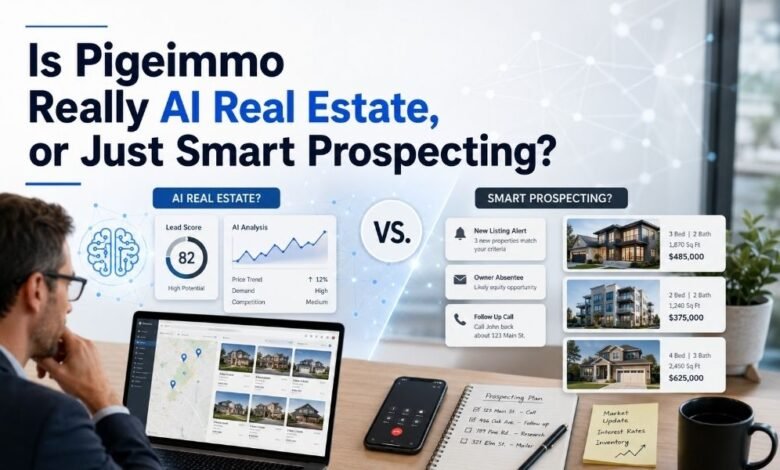
Pigeimmo is one of those online names that can confuse readers fast. Some people see it as a real estate prospecting tool. Others see it described as an AI real estate platform. Some articles even connect it with blockchain, smart contracts, and small property investments. That is why the question matters: is Pigeimmo really AI real estate, or is it just smart prospecting with a modern name?
The safest answer is not dramatic. Pigeimmo seems most strongly linked with property prospecting, listing alerts, and lead research. This means it may help real estate professionals find private property listings faster. But many of the bigger online claims need care. The Trendify Magazine page says Pigeimmo is linked with real estate prospecting and property leads, while broader claims about AI, blockchain, and fractional ownership are not clearly proven.
This article explains the issue in simple words. It looks at what Pigeimmo may do, why AI claims can be hard to trust, and what users should check before using any real estate tool.
The Basic Idea Behind Pigeimmo
At its most useful level, Pigeimmo appears to be connected with real estate prospecting. Prospecting means finding possible clients before they come to you. In real estate, this often means finding owners who are selling or renting a property by themselves.
A real estate agent may search many property websites each day. They look for new listings, owner details, asking prices, and locations. This work can take a lot of time. A prospecting tool can make the job easier by bringing some of this information into one place.
The reported Pigeimmo idea is simple. Instead of checking many websites again and again, a user may set filters. These filters can include city, property type, price, and number of rooms. The system may then show matching listings or send alerts when new ads appear.
That is not magic. It is smart organization. And for many agents, that alone can be useful.
What “Pige Immobilière” Means
To understand Pigeimmo, readers should know the French term “pige immobilière.” It is a common real estate practice in France. It means watching property ads, finding private sellers, and contacting them to offer agency services.
This is not just about collecting names. A good agent must still build trust. The seller may not want an agency at first. The agent must explain the value of their service. They may talk about pricing, photos, marketing, buyer checks, legal support, and negotiation help.
Traditional pige immobilière can be tiring. An agent may spend hours looking through listings. They may write notes by hand or use a spreadsheet. They may forget follow-ups. They may call too late and lose a possible mandate.
A tool like Pigeimmo can be useful if it makes this work faster and cleaner. It can help agents focus on real conversations instead of endless searching.
Pigeimmo vs Pigimmo: A Name Problem Readers Should Notice
One important issue is the name itself. Pigeimmo is often mixed with Pigimmo. Pigimmo, without the extra “e,” is a documented French real estate prospecting service from La Boîte Immo. La Boîte Immo describes Pigimmo as software for real estate professionals that helps with property monitoring, private listings, owner contact details, and prospecting work.
This matters because one extra letter can change the whole meaning. A reader may search Pigeimmo and find articles that talk about AI investing. Then they may search Pigimmo and find a more traditional real estate prospecting tool.
This creates a risk. People may assume every feature mentioned online belongs to the same service. That may not be true. Some writers may use the wrong spelling. Others may mix different products. Some may repeat claims from other articles without checking them.
Before signing up, paying money, or sharing personal details, users should check the exact company name, official website, legal notices, and service terms.
Why Real Estate Agents Care About Smart Prospecting
Real estate can move fast. A private owner may post a home for sale in the morning. By lunch, several agents may have already called. The agent who sees the listing first may have a better chance to start a useful talk.
This is why Pigeimmo sounds attractive. The value is not only in data. The value is also in timing. If a tool can alert an agent quickly, it may save time and improve the chance of contact.
Smart prospecting can also help agents stay organized. Instead of jumping between many tabs, emails, notes, and spreadsheets, they can keep leads in one place. They can see which owners they called. They can mark which listings are still active. They can plan follow-ups.
This kind of system does not need to be advanced AI to be helpful. A simple dashboard, good filters, and clear alerts can already solve a real problem.
Where the AI Claims Begin
The confusion starts when Pigeimmo is described as an AI-powered real estate platform. Some online descriptions mention property matching, lead scoring, market predictions, buyer behavior, and automated analysis. These features sound modern and exciting.
But strong AI claims need strong proof. A platform should explain what its AI does. It should say what data it uses. It should explain how predictions are made. It should show whether the results are tested. It should also make clear where the AI helps and where a human user still needs judgment.
The Trendify Magazine page says there is no clear public information showing which AI models Pigeimmo uses, what training data is involved, or how accurate its predictions are.
So readers should be careful. It is fair to say AI-assisted features are reported. It is not safe to say Pigeimmo is a proven advanced AI real estate system unless official details support that claim.
Automation Is Not the Same as Artificial Intelligence
This is the main point many readers miss. Automation and AI are not the same thing.
Automation follows rules. For example, a user may tell a system to show houses under €300,000 in one city. When a matching ad appears, the system sends an alert. That is useful, but it may not be AI.
AI usually means the system can learn from data, find patterns, or make predictions in a more advanced way. For example, it may score leads based on past seller behavior. It may predict which neighborhood could grow in demand. It may suggest which property owner is most likely to accept agency help.
The problem is that marketing often uses the word “AI” too easily. A tool may have filters and alerts, but still be called AI. This can mislead users.
Pigeimmo may be useful even if it is not advanced AI. The real question is not whether the word sounds modern. The real question is whether the tool helps users do real work better.
The Blockchain and Fractional Investment Claims Need Extra Caution
Some online claims go beyond prospecting. They describe Pigeimmo as a platform for blockchain real estate, smart contracts, tokenization, and fractional property ownership. Some even mention the idea of investing small amounts in property.
These claims should be treated with high caution. Real estate investment is not like joining a normal website. It involves money, ownership rights, contracts, tax issues, legal structure, and investor protection.
If a platform claims users can buy part of a property, many questions must be answered. Who owns the property? What does the user actually buy? Is it a share, a token, a contract, or something else? Who holds the money? How are profits paid? Can the user sell their share? What happens if the property loses value?
The Trendify Magazine page says there is not enough reliable evidence to confirm Pigeimmo as a public fractional property investment platform. It also says claims about blockchain and tokenization are not clearly verified.
That does not prove the claims are false. But it does mean readers should not treat them as confirmed.
The Real Industry Problem: Marketing Hype
Pigeimmo is part of a bigger problem in property technology. Many tools want to sound advanced. They use words like AI, blockchain, predictive analytics, smart contracts, and digital investing.
These words can be real. Some companies truly use advanced technology. But the words can also be used as hype. A normal lead tool may sound more powerful if it is described as AI. A basic listing dashboard may sound like a full investment platform if writers add blockchain language.
This matters because real estate is a high-trust industry. People make large financial choices. Agents pay for tools. Sellers share personal details. Investors may risk savings.
Good marketing should explain a product clearly. Bad marketing makes it hard to know what is real. With Pigeimmo, the safest article approach is to separate likely prospecting functions from unverified tech claims.
Privacy and Data Protection Concerns
Real estate prospecting often uses personal information. A private seller may put a phone number, email address, property address, or name in an ad. A prospecting tool may collect or display that information.
This creates privacy questions. In France and the European Union, personal data use must follow privacy rules. The French data protection authority, CNIL, says commercial prospecting is controlled by rules, and people may need to be informed, give consent in some cases, or have a clear way to object.
This is important for Pigeimmo users. Even if a tool collects data, the agent using the data still has duties. Software does not remove responsibility. An agent should know where the data comes from, how long it is stored, and how people can request deletion or object to being contacted.
Privacy is not a small detail. It is part of trust. A real estate tool that helps users contact sellers must also help users respect seller rights.
Phone Prospecting Rules Are Changing
Phone calls are a key part of real estate prospecting. But calling private sellers is not risk-free. France has rules for commercial telephone prospecting. CNIL says the rules changed from August 11, 2026. For consumers, prior consent is required unless an exception applies, such as a call linked to an ongoing contract.
The French economy ministry also states that it is forbidden to telephone a consumer for commercial canvassing without first getting consent.
This matters for any Pigeimmo article. If a tool helps agents find phone numbers, users still need to follow current rules. They should not assume every published number can be used for unlimited sales calls.
A responsible article should not present prospecting as “grab numbers and call everyone.” It should explain that legal and ethical contact matters. The best agents do not only move fast. They also act carefully.
What Users Should Check Before Trusting Pigeimmo
Before using Pigeimmo or any similar real estate tool, users should do a basic check. This is especially true when online claims are mixed.
Here are practical checks:
-
Check the official company name.
-
Check the legal notice page.
-
Read the terms and conditions.
-
Read the privacy policy.
-
Check current pricing.
-
Confirm cancellation rules.
-
Ask which websites are monitored.
-
Ask how often listings update.
-
Ask whether seller data is legally collected.
-
Ask whether phone compliance tools are included.
-
Ask whether AI features are real or only marketing language.
-
Ask for proof before trusting investment claims.
-
Never send investment money without checking regulation and ownership details.
These checks are not only for experts. They are for normal users too. If a website cannot explain who runs it, what it sells, how it uses data, and what users pay for, that is a warning sign.
For real estate agents, the key question is simple: will Pigeimmo help me find and manage leads better? For investors, the question is more serious: is this a real, regulated investment offer or just an online claim?
Final Thoughts
Pigeimmo is best understood with care. The most believable use case is real estate prospecting. It may help agents watch listings, find private sellers, manage leads, and save time. These are useful benefits. They can make daily work easier for agents who depend on fresh property leads.
But readers should not rush to accept every claim about Pigeimmo. AI, blockchain, smart contracts, and fractional property investing are serious claims. They need proof. They need clear company details. They need legal and technical information. They need transparency.
The honest view is this: Pigeimmo may be useful as a smart prospecting concept. It may help real estate professionals work faster. But until stronger official information proves the broader claims, it should not be described as a fully verified AI real estate investment platform.
Good technology does not need hype to be useful. A clear, honest prospecting tool can still have real value. The best way to judge Pigeimmo is not by big tech words. It is by what the tool can prove, what it clearly offers, and how safely users can use it.