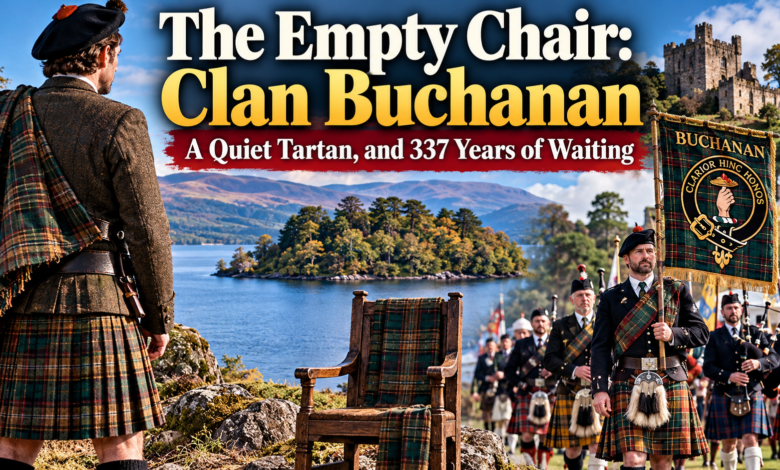
Just off the village of Balmaha, on the eastern shore of Loch Lomond, there is a small wooded island called Clairinch. You can row to it in ten minutes. Nobody lives there, and nothing much has happened on it for several hundred years.
For the Buchanans it was once the centre of the world. When the clan was called to arms, the word that went along the lochside and up into the hills was the name of that island: Clar Innis! Men left their ploughs and their boats and came. It was the gathering cry of a people who had held that shore since 1225, when the Earl of Lennox granted land beside the loch to a clergyman named Absalon of Buchanan. The clan that answered that cry now has two tartans, the bright clan sett and the quieter Buchanan Hunting tartan, and it is the quiet one this story follows.
Then, in the early 1680s, the cry went out and there was nobody to answer to. The last chief, John Buchanan of that Ilk, died without a son and buried in debt. The estate went to his creditors and ended up with the Grahams of Montrose, who would later raise the great pile of Buchanan Castle near Drymen. The line of chiefs that had run for four and a half centuries simply stopped.
What happened next is the interesting part. A clan without a chief, without land, without any legal existence, declined to go away.
A clan that ran itself
Most people assume clans were held together by their chiefs. The Buchanans are the awkward counter-example.
In 1725 a group of men of the name in Glasgow founded the Buchanan Society, a charity to support poor clansfolk and educate their children. It is still going, and it is generally reckoned the oldest clan society in the world. It was set up forty years after the chiefship lapsed, which means the Buchanans organised themselves into a modern institution at the precise moment the old one had failed them.
The name spread. It already had its famous men. George Buchanan, the sixteenth-century humanist and historian, had been tutor to the young James VI and one of the most learned men in Europe. A branch settled in Ulster, and from that branch came James Buchanan, fifteenth President of the United States. By the nineteenth century there were Buchanans in every colony. In 1970 a group of them met at the Highland games on Grandfather Mountain in North Carolina and founded what became the Clan Buchanan Society International, now one of the largest clan societies anywhere.
All this time the chief’s chair stood empty. Under Scots law a chiefship does not die. It passes down the blood line to whoever is the nearest heir, whether or not that person knows it. Somewhere, the Buchanans understood, there was a chief. It was a question of finding him.
It took years of work in archives, tracing cadet branches back through the centuries to establish which line stood closest to the last chief. In 2018 the Lord Lyon King of Arms, who rules on such matters, gave his decision. John Michael Baillie-Hamilton Buchanan of that Ilk and Arnprior was recognised as chief of the name. The vacancy had lasted 337 years.
He was formally inaugurated in October 2022 at Cambusmore, near Callander. Buchanans came from all over the world to see it. There had not been a ceremony like it in anyone’s memory, or in their great-great-great-grandparents’ memory either.
Loud and quiet
A family with a story like that ought to have a distinctive tartan, and it does. The main Buchanan sett is one of the most recognisable in Scotland: big squares of yellow, red and green, cut through with black, blue and white. It is joyful and completely unignorable. A pipe band in it can be seen from the next county.
It is less helpful at a funeral, or a job interview, or on an ordinary Saturday. For those there is the other one.
The hunting tartan belongs to a type that appeared in the nineteenth century, when Highland dress became something people wore outdoors on sporting estates and clans with bright tartans wanted something calmer. The method was to swap the loud ground for the colours of moor and woodland and keep a line or two of the original as a signature.
In the Buchanans’ case the paper trail has a pleasing twist. The Scottish Register of Tartans lists more than one pattern under the name. One comes from a book of weavers’ samples dating from around 1850: brown and green blocks divided by black, with one fine line of azure and one of yellow. According to mill notes preserved in the register, this version fell out of production, was rediscovered and revived by an American firm in the 1960s, and has since become a strong contender for the accepted sett. Another entry records a specimen in blue, brown and green with a red line, presented to the Highland Society of London by Sir Charles Buchanan in 1955.
So the quiet tartan, like the clan, went missing for a while and was brought back by the diaspora. Anyone ordering Buchanan Hunting tartan should look at the swatch to see which version a supplier weaves, and buy every piece of an outfit from the same source so that it matches. Retailers typically carry the clan’s tartans together, the bright one and the hunting, made to order as kilts, waistcoats, trousers, skirts and scarves and as cloth by the yard. Utility versions, cut as hard-wearing kilts for men with cargo pockets, carry the hunting sett particularly well.

Friday
To see how the clan’s cloth is actually worn now, go to a Highland games. Any big one will do. Go the day before it opens.
Friday is when the work is done. The field is a mess of vans, tent poles and coils of rope. At the Clan Buchanan pitch, four men are putting up a marquee. They are hot, there is a mallet involved, and somebody has lost the bag of pegs.
Look at what they are wearing. Three of the four are in kilts, and none of those kilts is tartan. They are heavy cotton, black or olive or khaki, with big cargo pockets on each side, belt loops, snap fastenings and metal D-rings at the hip. One man has a tape measure clipped to his. Another has his phone in one thigh pocket and a bottle of water in the other. They sit lower than a traditional kilt, about where jeans sit, and nobody is wearing a sporran because nobody needs one.
This is the utility kilt. It appeared in the American Pacific Northwest around the year 2000, was sneered at by traditionalists for a few years, and then quietly became normal. It keeps the architecture of the real thing, flat apron in front, pleats behind, and rebuilds it as workwear. The good ones are cut from heavy pure cotton, because thin blends lose their pleats and cling in the heat, and are made to the wearer’s measurements, not sold by trouser size. They go in the washing machine.
A specialist’s range of modern kilts for men will show how far the idea has travelled: plain working kilts, hi-vis versions for site work, tactical and camouflage models, gothic styles hung with hardware, and hybrids that set tartan pleats into a plain cotton front. That last one is the clansman’s compromise. Pockets at the side, the family sett at the back. One of the men hammering pegs is wearing exactly that, with the brown and green of the hunting tartan flashing in the pleats each time he bends.
Saturday
Come back the next morning and the same four men are unrecognisable.
The marquee is up, the banner is out, and the table is covered in leaflets and a bowl of shortbread. The men are in tartan. Two wear the big yellow sett, because it is a festival and that is what it is for. Two wear the hunting tartan, eight yards of it, pleated deep, with tweed waistcoats, brown leather sporrans, green hose and polished brogues. One has the clan crest on his bonnet: a hand holding up a ducal cap, inside a strap and buckle bearing the words Clarior hinc honos, brighter hence the honour.
A traditional kilt is a formal garment even in a subdued cloth. It sits high at the navel, hangs to mid-knee, and wants the full set of accessories. It is right for the parade of clans, for the wedding next month, for the Burns supper in January. It would have been absurd yesterday, in the dust with a mallet.
That is the modern clansman’s wardrobe in a sentence. One kilt for the great days, in the family’s tartan, made to last thirty years. One for all the other days, in cotton, made to be worked in. The same boots, belt and rolled-down socks serve with both when things are casual. Most men who own the pair will tell you the cotton one gets ten outings for every one the tartan gets, and that they would not part with either.
At noon the clans march onto the field behind the pipes, each behind its banner. When the announcer reaches the Buchanans, a shout goes up from the four men and the thirty others walking with them. It is the name of a little wooded island in a loch most of them have never seen.
What lasted
The Buchanans lost their land in the 1680s and their chief for the next three and a third centuries. By any reasonable reckoning that should have finished them. What kept the clan alive was not a castle or a title. It was a charity in Glasgow, a society founded on a mountain in Carolina, a great many families who kept telling their children where the name came from, and a habit of turning up.
The clothes are part of that habit. A quiet green and brown tartan, lost for a century and revived from a Victorian sample book. A cotton kilt with cargo pockets that no chief of the old line would have recognised as a kilt at all. Both are worn by people who answer to the same cry, and both would have been welcome at Cambusmore on the day the chair was filled again.