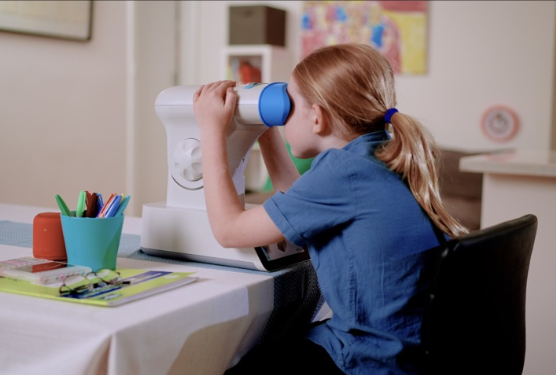
For decades, a nearsighted child simply got a stronger pair of glasses each year as the prescription crept up. Eye care has moved on. Myopia now affects roughly 40% of the U.S. population, and researchers estimate that more than half the world may be myopic by 2050. Today, eye doctors treat childhood myopia as a progressive condition that can be slowed, not just corrected.
Quick answer: The leading evidence-based myopia management treatments for children are myopia control glasses (such as Essilor Stellest), orthokeratology (overnight reshaping lenses), dual-focus daily contact lenses (such as MiSight 1 day), and low-dose atropine eye drops. Each slows how quickly the eye grows longer. The right choice depends on the child’s age, prescription, progression rate, and lifestyle.
Why Slowing Myopia Matters
Myopia progresses during the school years because the eyeball grows too long from front to back. This measurement, called axial length, is the key number in myopia management for children in Cary, NC. A longer eye means a higher prescription and a greater lifetime risk of retinal detachment, myopic maculopathy, glaucoma, and early cataracts.
Standard single-vision glasses correct blurry vision but do nothing to slow that growth. Myopia management uses specially designed lenses or eye drops to slow progression while the child still sees clearly. No treatment reverses myopia, but slowing it during childhood can protect a child’s eye health for life.
The Top Myopia Management Treatments for Children
1. Myopia Control Glasses
Best for: Younger children and families who want a simple, non-invasive starting point.
These look like ordinary glasses, but a pattern of tiny lenslets around a clear centre creates peripheral myopic defocus, an optical signal that helps slow eye growth.
Essilor Stellest lenses became the first eyeglass lenses authorized by the FDA to slow myopia progression, in September 2025, for children aged 6 to 12. In the two-year study, children wearing them showed a 71% reduction in myopia progression and 53% less eye elongation than children in standard lenses. MiYOSMART lenses from HOYA use similar defocus technology and showed comparable results in a two-year trial, although regulatory status varies by country.
The glasses need to be worn consistently throughout the day, and some children notice mild peripheral blur while adapting.
2. Orthokeratology (Ortho-K)
Best for: Active children, swimmers, and families who want glasses-free days.
Ortho-K lenses are custom rigid contact lenses worn overnight. They gently reshape the cornea while the child sleeps, giving clear vision all day without glasses. A 2019 American Academy of Ophthalmology report found that ortho-k typically reduced axial elongation by around 50% over two years, with a potentially greater effect in younger children.
Ortho-K requires precise fitting, strict lens hygiene to minimise infection risk, and regular follow-ups, so families should look for a clinic experienced in myopia control treatments in Cary, NC rather than a standard contact lens fitting. In the U.S., its use for myopia control is considered off-label.
3. Dual-Focus Daily Contact Lenses
Best for: Children aged about 8 to 12 who are ready for contact lenses.
MiSight 1 day by CooperVision was the first FDA-approved product to slow myopia in children, approved in 2019 for ages 8 to 12. These daily disposable lenses correct vision in the centre and use treatment zones to create defocus. Over three years, MiSight slowed progression by 59% and axial elongation by 52% on average. Fresh lenses every day mean no cleaning routine, although the ongoing cost is a factor for some families.
4. Low-Dose Atropine Eye Drops
Best for: Fast progressors, or as part of a combined treatment plan.
A single very low-concentration atropine drop at bedtime has been shown in many studies to slow myopia progression with few side effects. As of late 2026, there is no FDA-approved low-dose atropine product in the U.S., so doctors prescribe compounded drops, which insurance rarely covers. Atropine is often combined with myopia control glasses or contact lenses for children who are progressing quickly.
5. Healthy Visual Habits
Lifestyle changes are not a stand-alone treatment, but they support every option above:
- Aim for 90 to 120 minutes outdoors each day.
- Follow the 20-20-20 rule: every 20 minutes, look at something 20 feet away for 20 seconds.
- Keep books and screens at a comfortable distance, not close to the face.
Myopia Treatments at a Glance
| Treatment | Typical age | U.S. status | Key benefit |
| Myopia control glasses | 6 to 12 (Stellest) | Stellest FDA-authorized (2025) | Non-invasive, easy for young children |
| Orthokeratology | Often 6+ | Off-label for myopia control | Glasses-free days |
| MiSight 1-day contacts | 8 to 12 | FDA-approved (2019) | No cleaning, daytime freedom from glasses |
| Low-dose atropine | Broad range | Compounded only | Simple nightly routine |
How Parents Can Choose the Right Treatment
There is no single best treatment for every child. A good eye doctor weighs the child’s age, current prescription, how fast it is changing, family history, activities, and the family’s budget. Younger children often start with myopia control glasses, older and more active children may prefer ortho-k or daily contacts, and fast progressors may need a combined approach.
What a Proper Myopia Evaluation Should Include
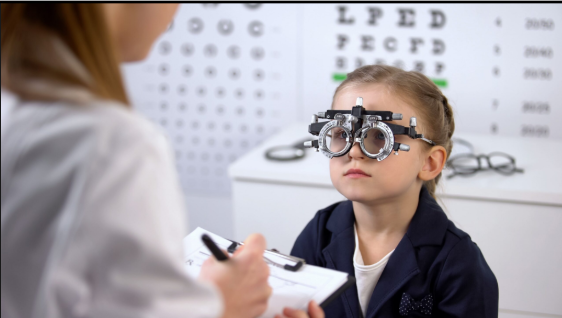
A routine eye exam measures a child’s prescription. A dedicated myopia evaluation goes further, with axial length measurement using optical biometry, a personalised treatment plan, and follow-up visits roughly every six months. Tracking axial length over time matters because a prescription can look stable while the eye is still quietly growing.
Parents should consider booking an evaluation if a child squints at distant objects, sits close to screens, complains of headaches after school, or needs a stronger prescription at every visit.
The Bottom Line
Childhood myopia no longer means simply updating glasses every year. With FDA-authorized options like Stellest and MiSight 1 day, alongside orthokeratology and low-dose atropine, parents now have proven ways to slow progression. The most important first step is a comprehensive myopia evaluation with axial length measurement, followed by a treatment plan that fits the child and regular monitoring to confirm it is working. For families in Cary and Raleigh, North Carolina, Eye Solutions offers measurement-led myopia management, including ortho-k and myopia control spectacle lenses, to help children keep their vision healthier for the long term.