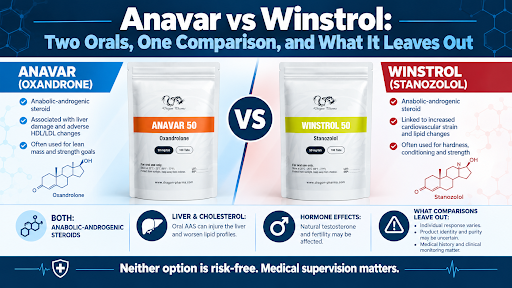
Ask anyone comparing orals and the same pair comes up: oxandrolone and stanozolol, sold as Anavar and Winstrol. The comparison is so routine that it is usually settled in a sentence, one is described as mild and the other as harsh, and that is treated as the answer.
The shorthand is not wrong so much as incomplete. The two compounds differ structurally in a way that changes their side-effect profiles, their effect on joints, and the form the product arrives in. Understanding those differences is more useful than memorising a verdict, and it is also the only way to tell whether a listing is describing the compound it is selling.
Why these two are always compared
Both are oral, both are C17-alpha-alkylated, and both are associated with cutting phases rather than mass gain. That combination of shared traits is what makes them interchangeable in conversation. Neither aromatises meaningfully, so neither produces the water retention associated with testosterone or nandrolone, and both are handled by buyers looking for a leaner presentation.
Where the comparison usually goes wrong is treating those shared traits as the whole picture. They share a route of administration and a class, not a mechanism.
The structural difference that changes everything
Oxandrolone is a dihydrotestosterone derivative. Its structure includes an oxygen heteroatom in the A-ring, which is what distinguishes it from the parent hormone. Stanozolol is also a DHT derivative, but it carries a pyrazole ring fused to the A-ring instead of the ketone that oxandrolone has.
That single difference sets the two apart in three practical ways: how well each survives oral administration, how each behaves at the androgen receptor, and which side effects dominate. It is the reason one is routinely described in clinical literature and the other is not, and the reason a product label cannot be read as interchangeable between them.
What “mild” means, and what it does not
Oxandrolone earned the mild label partly because it was studied in clinical settings, including in patients with catabolic conditions, at low doses over extended periods. That clinical history is real and it is the reason the compound has a documented safety discussion at all.
Mild is not the same as safe. Both compounds are C17-alpha-alkylated, and that alkylation is what allows them to survive the first pass through the liver. It is also what makes both hepatotoxic to some degree, and the marker to watch with either is not how the compound feels but what liver enzymes do. Anyone presenting one of these as liver-safe is describing a dose they have not measured.
The joint question
This is the difference most often felt rather than read about. Stanozolol is widely reported to dry out connective tissue, producing joint discomfort in people who otherwise tolerate it well. Oxandrolone is reported to do the opposite, sometimes markedly so, and is used by some specifically because of that.
Neither report is a controlled finding, and both are the kind of anecdote that hardens into folklore. But the pattern is consistent enough that it shapes how the two are chosen, and it is one of the few places where the compound rather than the dose determines the experience.
Estrogen, water and the “dry” label
Both are described as dry, and with both the description needs qualifying. Neither aromatises to any meaningful degree, which is true and matters. But dryness in this context usually means no water retention, not no estrogen. Oxandrolone in particular has been reported to affect SHBG and, at higher doses, to produce effects that are not simply explained by an absence of aromatisation.
For buyers, the practical consequence is that a listing calling either compound dry is making a claim about water, and inferring the rest from it is unsupported.
Stacking them: what an anavar and winstrol cycle actually does
Running the two together is a common combination and a logical one on paper, since both are oral and neither aromatises. The reason it is usually a poor idea is not pharmacological subtlety: it is that two C17-alpha-alkylated compounds means the liver is handling two alkylated molecules at once, and the combined hepatic load is the constraint that matters.
Anyone set on the combination should understand that they are doubling a specific risk rather than adding two benefits, and that the two compounds do overlap significantly in what they deliver. A cycle pairing built around the two is best read as a description of a stack, not a recommendation of one.
Dose, duration and the limit that matters
This is a comparison about which product to describe accurately, and it is worth saying that duration is the variable most often underestimated with both. Oxandrolone is frequently described as the gentler option and then run for longer than the harsher one, which inverts the risk calculus entirely. The same logic applies to dose per unit: stanozolol is commonly presented in 10 mg and 50 mg oral tablets, oxandrolone in 10 mg, and a listing that does not state dose per tablet is not giving you the information you need to compare anything.
What to check before buying either
With both compounds the verification burden sits with the buyer, and the checks are the same for each. First, identity: mass spectrometry on the finished product, batch-specific, not a generic certificate reused across products. Second, dose per unit, which for orals is trivially easy to misstate. Third, the presentation, because oxandrolone and stanozolol are both heavily counterfeited and the packaging is where that shows.
For oxandrolone specifically, tablet count and stated milligram strength have to reconcile with the price, because the raw material is expensive and a bargain on this compound is usually a statement about what is in the tablet. For stanozolol, the oral and injectable forms are different products with different handling requirements, and listings that blur them are worth avoiding. If you are comparing what is actually available, buy anavar online and buy winstrol 50mg show the two catalogued side by side, and the anavar and winstrol cycle page sets out how the pair is usually presented.
The injectable question
Oxandrolone is oral in commercial practice. Stanozolol is not, and that asymmetry is the most practical difference between the two when you are reading a catalogue rather than a forum thread. Stanozolol is sold both as an oral tablet and as a suspension for injection, and the two are not interchangeable products even though they contain the same molecule.
The injectable form is a water-based suspension, meaning the drug is present as particles rather than dissolved. Those particles settle, the draw is not homogeneous, and the dose actually delivered depends on how the vial was handled before it reached you. That is a formulation problem rather than a dosing one, and it is why presentation matters more with this compound than with one supplied as a solution.
The consequence for any comparison is that the two compounds are not symmetrical. One has a single commercial form; the other has two, which are routinely discussed as though they were one product. They share a molecule and a reputation. They do not share a handling profile, and a listing that does not state which form it is selling has not told you what you are buying.
Frequently asked
Are Anavar and Winstrol the same class?Both are oral C17-alpha-alkylated steroids and both are DHT derivatives, but their ring structures differ, which is why their side-effect profiles are not equivalent.
Do either of them aromatise?Not to any meaningful degree. Neither converts to estrogen the way testosterone does, which is why neither is associated with water retention.
Which is harder on the liver?Both are hepatotoxic because both are 17-alpha-alkylated. The relevant variable is total alkylated load and duration, not which of the two is nominally gentler.
Why is Winstrol associated with joint pain?It is widely reported to affect connective tissue, producing joint discomfort. The mechanism is not well characterised, but the report is consistent enough to influence how it is chosen.
What is the single most useful thing to check on a listing?Dose per tablet and a batch-specific laboratory result. A listing missing either is not giving you enough to compare one product against another.
The bottom line
Oxandrolone and stanozolol sit in the same class and get used for similar goals, but they are not interchangeable, and the differences that matter are structural rather than a matter of degree. One has a clinical history and a reputation for being gentle; the other is harsher, cheaper per milligram to produce, and notorious for joints.
The most useful correction is about the mild label. Neither compound is mild in the sense that matters, because both are alkylated and both load the liver. Whichever of the two a listing describes, the questions worth asking are the same: what is in the tablet, how much of it, and can the seller prove it. The full oral range is the place to see what forms exist before comparing individual products.