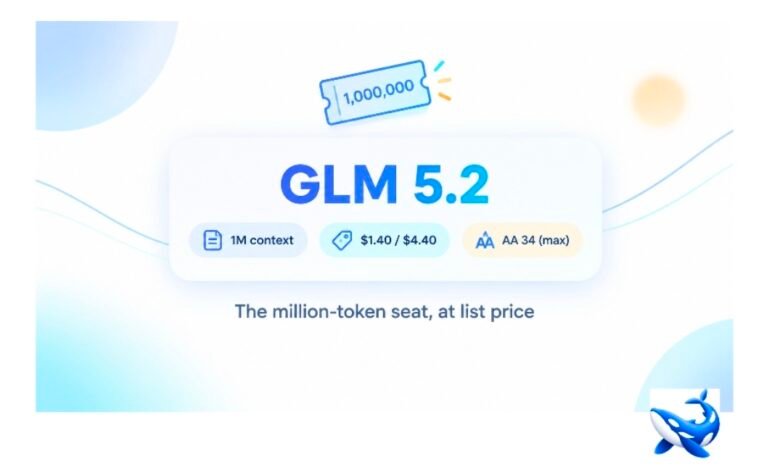
On OrcaRouter we host the GLM 5.2 model — the general-purpose flagship of the Z.ai lineup, shipped on June 16, 2026, priced at $1.40 per million input tokens and $4.40 per million output, with a 1M-token context window and a 128K maximum output. Artificial Analysis scores it 34 at its highest configuration, with an output speed of 86.8 tokens per second and a per-task cost of $1.47. In production its p50 time-to-first-token is 7.50 seconds and its seven-day token volume is 67.3 million. It is carried at list price on the same key as every other Z.ai model, with the live telemetry on the linked page.
A full million tokens of context for $1.40 — the arithmetic is the headline, and this article is about what that arithmetic actually buys.
What a dollar-something input buys
The rate card is the first story: $1.40 per million input tokens and $4.40 per million output puts a 1M-token context window within budget of a long-running analysis job. A 500,000-token corpus pass costs seventy cents at list input price; a full million-token prompt is $1.40. That is not a premium buy — it is the kind of number that changes whether a team even bothers chunking. When the whole context fits in one prompt at a dollar-something, the chunk-and-reassemble pipeline stops being the default.
The independent record backs the value angle without flattering it. Artificial Analysis reads GLM 5.2 at 34 (max) with a per-task cost of $1.47 — a competent score, not a ceiling, at a cost a third below the fleet’s premium rungs. The card’s argument is exactly the pair: enough quality that the 1M context is worth filling, and a price low enough that filling it is routine.
The million-token value rung on the board
| model | context | max output | input / output | AA index | per-task cost | output speed | p50 TTFT | 7-day tokens |
| GLM 5.2 | 1M | 128K | $1.40 / $4.40 | 34 (max) | $1.47 | 86.8 tok/s | 7.50 s | 67.3M |
| Qwen3.7 Max | 1M | 64K | $1.25 / $3.75 | 29 | $1.15 | 199.8 tok/s | 1.27 s | 37.5K |
| Kimi K3 | 1M | not listed | $3 / $15 | 44 (max) | $2.00 | 41.7 tok/s | 8.38 s | 611.6M |
Context windows, output ceilings and rate cards are what the vendors list; the index scores, per-task costs and output speeds are Artificial Analysis’ live readings; the TTFT and token columns are production telemetry from the linked pages. The table is the million-token club, and it makes GLM 5.2’s seat precise: a 34 (max) score between the value rung and the premium flagship, a per-task cost between theirs, and a $1.40 / $4.40 rate below both on the input side. It is not the ceiling card, not the speed card, and not the traffic card — it is the card that makes a million tokens an everyday price, and the 67.3 million weekly tokens show the market using exactly that seat.
The honest wait behind the value
The value arithmetic is real, and so is the trade that pays for it. The p50 first token of 7.50 seconds on our production record is the slowest in this article’s table — a full-megabyte prompt does not answer in a second, and for interactive chat GLM 5.2 will feel deliberate. This article will not dress the number up: the seat is bought for the context, not for the first token, and a team that needs instant responses should look at the fleet’s faster rungs.
The 86.8 tokens per second output speed is the compensating figure. Once the first token lands, the generation streams at nearly ninety tokens a second — faster than the flagship in the table — which means the wait is front-loaded: one deliberate pause, then a fast run. For the workloads this card is for, that shape is acceptable: the input is the expensive part of the job, the output is comparatively modest, and the 7.50-second wait is amortized across a task that spends minutes in the context.
The workloads the 1M seat serves
The profile that fits GLM 5.2 is the one the 67.3 million weekly tokens already demonstrate: deep-context analysis over corpora that other models force a team to chunk. Long document suites, multi-file codebases read whole, extended retrieval over a month of logs — each becomes a single prompt at a dollar-something, and the 128K output ceiling covers the long summaries those jobs produce. The score of 34 (max) is competent for this work, and the 86.8-token stream keeps the finished answer quick.
The honest boundary mirrors the table: where the job needs a premium ceiling, the flagship rung scores higher; where the job is interactive, the 7.50-second first token is a real cost. GLM 5.2 is the value seat of the million-token club — the card that makes full-context work cheap enough to run routinely, at a score high enough to trust the results. The linked page shows the price, the score, and the traffic that already runs there.
One number in the table deserves a second look before the verdict, because it is the strongest evidence the seat is being used as designed: the 67.3 million weekly tokens against the 37.5K of the fast premium rung beside it. The fast card is nearly three times quicker on the input dollar and answers its first token in 1.27 seconds, yet it moves a rounding error of the traffic — the market is not routing its deep-context work to the speed rung, it is routing it here, to the rung where a million-token pass is a routine bill. That is the difference between a spec and a seat: a card is what the board says, a seat is what the traffic says, and the traffic says this is the million-token seat teams actually run.
The takeaway
GLM 5.2 is the Z.ai general-purpose flagship: $1.40 / $4.40, a 1M context window and a 128K maximum output, an independent score of 34 (max) at 86.8 tokens per second and $1.47 per task, and a p50 first token of 7.50 seconds on our production record. Its 67.3 million weekly tokens show a market using the dollar-something million-token seat at scale. It is the value rung of the 1M club — the card that makes filling a full context an everyday price, with a deliberate first token as the honest trade. If your job is deep-context work, this is the ticket — live at list price, with the telemetry on the linked page.
Sourcing note: release date, context window, output ceiling and rate card are what Z.ai lists and have not been independently reproduced. The Intelligence Index score (the “34 (max)” figure is the highest configuration the benchmark site lists), output speed and per-task cost are from Artificial Analysis’ live model page, read 2026-10-08. The p50 time-to-first-token and seven-day token volume are OrcaRouter production telemetry from the linked model page. All checked 2026-10-08.